
Emergency Funds: How Much You Need and Where to Keep It
Life is remarkably good at surprising you, and rarely with good news. The car transmission dies the same week your hours get cut. A tooth cracks on a Saturday night. The water heater picks the coldest week of the year to retire. None of these are anyone’s fault — they’re just what happens when you’re a person with stuff that can break.
An emergency fund is money set aside specifically for those moments. Not for vacations, not for a sale, not for “I deserve it.” It’s the financial equivalent of a fire extinguisher: boring, unglamorous, and the best thing you own on the worst day of your year.
Why an Emergency Fund Comes Before Almost Everything
Here’s the logic. Without an emergency fund, every surprise becomes debt. The $1,200 car repair goes on a credit card at 24% APR, and now you’re paying interest on bad luck for months. With an emergency fund, the same repair is just an annoying Tuesday — you pay cash, refill the fund over the next few months, and move on.
Financial planners almost universally rank building an emergency fund above investing, above extra debt payments (beyond minimums), above nearly everything except capturing an employer’s 401(k) match. The reason is simple math: the return on avoiding 24% credit card interest beats the return on almost any investment you could make.
How Much Do You Actually Need?
You’ve probably heard the standard answer: three to six months of essential expenses. Let’s unpack what that really means, because the details matter.
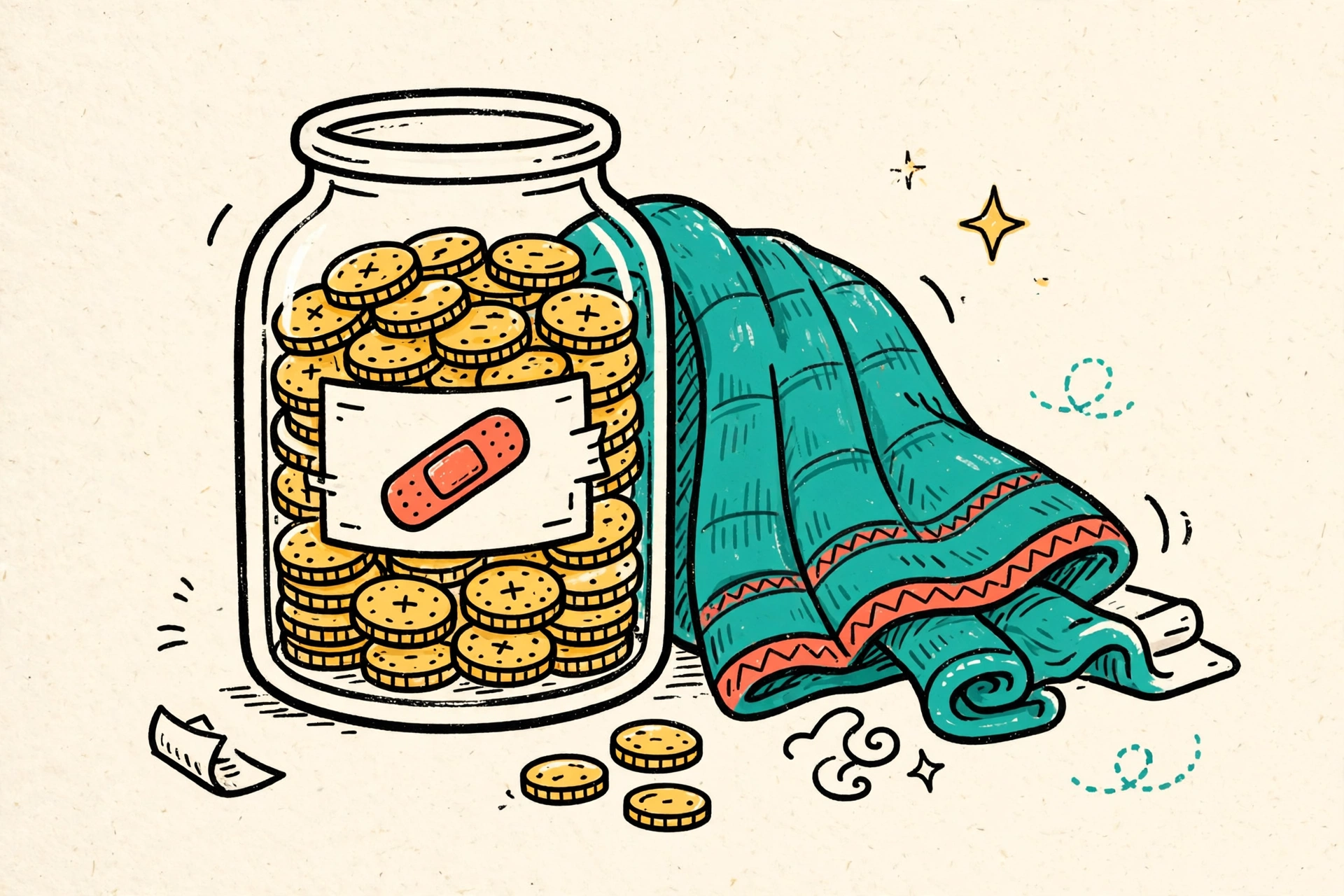
Start with a $1,000 mini-fund
If you’re starting from zero — especially if you have high-interest debt — don’t aim for six months on day one. Aim for $1,000 first. That number isn’t magical; it’s psychological and practical. $1,000 covers most single emergencies (a car repair, an appliance, an urgent vet bill) and gives you the experience of having a buffer. It changes how you feel about money, which changes how you act.
Get there however you can: sell things you don’t use, pick up extra shifts for a month, temporarily redirect your fun money. Speed matters more than elegance here.
Then build toward 3–6 months of essential expenses
“Essential expenses” means what it takes to keep your life running: housing, utilities, groceries, insurance, transportation, minimum debt payments. Not restaurants, not subscriptions, not shopping. For most people, essential expenses run 60–75% of their total spending.
Where you land in the 3–6 month range depends on your situation:
- Closer to 3 months if you have a stable salaried job, dual incomes in the household, strong disability insurance, or could easily find comparable work.
- Closer to 6 months if you’re self-employed, a freelancer, or a gig worker; if you’re the sole earner; if your industry does layoffs in waves; or if you have dependents.
- Beyond 6 months can make sense for commission-only earners, people with chronic health conditions, or anyone whose income is genuinely volatile.
A concrete example: if your essential monthly expenses are $3,000, your target is $9,000–$18,000. That sounds like a lot — and it is — which is why you build it gradually. Even $200 a month gets you to $9,000 in under four years, and every dollar along the way is already protecting you.
Where to Keep Your Emergency Fund
The right home for emergency money has three properties: it’s safe (you can’t lose it), liquid (you can get it within a day or two), and separate (you won’t accidentally spend it). That narrows the options fast.
Best: a high-yield savings account (HYSA)
A high-yield savings account at an FDIC-insured bank or NCUA-insured credit union is the sweet spot. Your money earns a competitive interest rate, it’s insured up to $250,000 per depositor per institution, and you can transfer it to checking in a day or two. Many online banks pay rates dramatically higher than traditional brick-and-mortar savings accounts — sometimes 10x more — with no minimums and no monthly fees.
Keep it at a different bank from your checking account if you can. The slight friction of a 1–2 day transfer is a feature, not a bug: it stops impulse raids while still being fast enough for any real emergency.
Fine: a money market account
Money market accounts at insured banks offer similar safety and liquidity, sometimes with check-writing privileges. Rates are usually comparable to HYSAs. Either choice is perfectly good.
Avoid: investing it, crypto, or cash under the mattress
Emergency money doesn’t belong in the stock market. Stocks can drop 20–30% in a bad year — and bad years for stocks have an unpleasant habit of coinciding with layoffs, which is exactly when you’d need the money. Crypto is even more volatile. And cash at home earns nothing, isn’t insured against theft or fire, and is far too easy to “borrow” from yourself. Your emergency fund’s job isn’t to grow; its job is to be there.
What Counts as an Emergency?
This is where most emergency funds die — not in a crisis, but in a slow bleed of almost-emergencies. So let’s draw the line clearly.
Emergencies: job loss, medical bills, essential car repairs, emergency home repairs (roof leak, broken furnace), urgent travel for a family crisis, a vet emergency for a pet you love.
Not emergencies: a vacation deal, holiday gifts, a phone upgrade, concert tickets, a sale on something you wanted, your annual car insurance premium (that’s a predictable expense — budget for it monthly instead).
The test is simple: was it unexpected, urgent, and necessary? All three. A new couch fails all three. A cracked tooth passes all three. When in doubt, sleep on it for 48 hours — real emergencies don’t get less urgent in two days, but temptations do.
How to Build It Without Feeling It
- Automate a transfer on payday. Even $50–$100 per paycheck, moved to your HYSA before you can touch it. This is the “pay yourself first” principle from budgeting, applied to safety.
- Save windfalls by default. Tax refunds, bonuses, birthday money, cash from selling stuff — decide in advance that half of every windfall goes to the emergency fund. You still enjoy the other half.
- Redirect a killed expense. Cancelled a $15/month subscription? That $15 now goes to the emergency fund automatically. You were already living without the money.
- Name the account. Most banks let you nickname savings accounts. “Do Not Touch — Emergencies” is surprisingly effective behavioral design.
What If You Have to Use It?
Then it did its job — congratulations, the system worked. Don’t feel guilty; that’s literally what the money was for. Two rules for the aftermath:
- Refill it before resuming other goals. Pause extra debt payments and investing contributions temporarily and redirect that cash flow to rebuilding the fund. You’re vulnerable until it’s whole again.
- Replenish to the same target. Don’t quietly lower the bar because rebuilding feels slow. The next emergency doesn’t care that the last one was expensive.
Once your emergency fund is fully stocked, your money can start working harder — that’s when concepts like compound interest and long-term accounts like a Roth IRA enter the picture. The emergency fund is what lets you invest with confidence instead of anxiety, because you know a surprise won’t force you to sell at the worst moment.
FAQ
Should I pay off debt or build an emergency fund first?
Do both, in sequence: build the $1,000 starter fund first, then attack high-interest debt aggressively while maintaining minimum payments everywhere. Once the expensive debt is gone, finish building the full 3–6 month fund. The starter fund exists so that the next surprise doesn’t land on a credit card and undo your debt payoff progress.
Is $1,000 really enough to start?
It’s enough to start, not enough to finish. $1,000 covers the most common single emergencies — the average car repair, a minor medical bill, a broken appliance — and it breaks the paycheck-to-paycheck psychology. Think of it as phase one of a two-phase plan, not the destination.
Can I keep my emergency fund in a CD?
A certificate of deposit pays a fixed rate but locks your money up for a term, with penalties for early withdrawal. That illiquidity defeats the purpose. The one exception some people use: once the fund is large, keep one month of expenses in savings and the rest in a short-term CD ladder — but for most people, a HYSA is simpler and flexible enough.
What if I keep raiding my emergency fund for non-emergencies?
Then the problem isn’t the account, it’s the access. Move it to a separate bank with no debit card attached, remove the app from your phone, and use the three-question test (unexpected? urgent? necessary?) before every withdrawal. If “emergencies” keep happening monthly, some of them are actually predictable expenses in disguise — car maintenance, annual bills, holiday spending — and those belong in your monthly budget as sinking funds, not in the emergency fund.
DotWealthy is for education only, not financial advice. Everyone’s situation is different — consider talking to a qualified financial professional before making big money decisions.