
What Is a Budget and How to Start One
You have probably heard that you need a budget. It shows up in every personal finance article, every money podcast, every well-meaning conversation with your parents. And yet most people still don’t have one — not because they’re lazy, but because the word “budget” sounds like punishment. It sounds like a list of things you can’t do.
Here’s the reframe that makes everything click: a budget isn’t a diet for your wallet. It’s a plan for your money. Every dollar you earn already has a job to do — go toward rent, cover groceries, pay down a card, sit quietly in savings, or yes, buy the thing that makes you happy. A budget just decides those jobs ahead of time instead of letting the month happen to you.
People with budgets aren’t people who never spend. They’re people who spend on purpose.
What a Budget Actually Is
Strip away the apps and spreadsheets, and a budget is just three numbers: how much comes in, how much goes out, and what the difference is. If the difference is positive, that money goes somewhere on purpose — savings, debt, investing. If it’s negative, you have a leak to find, and now you know exactly where to look.
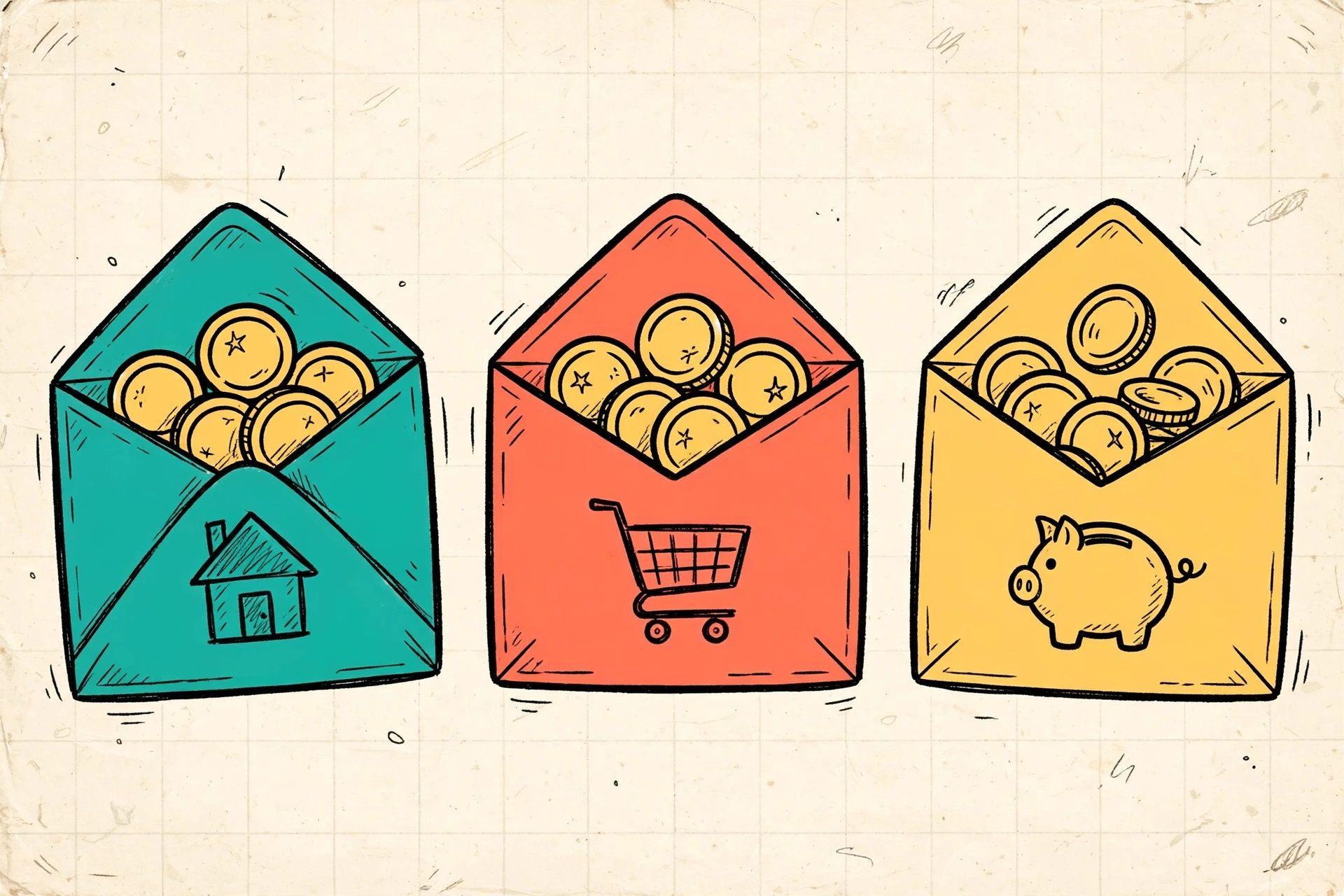
That’s really it. A budget doesn’t care whether you use a fancy app, a paper envelope system, or a napkin. The format matters far less than the habit: look at your money regularly, and tell it where to go before it disappears.
Why does this matter so much? Because money is sneaky. Studies of household spending consistently show that people who don’t track their spending underestimate it — sometimes by a lot. Small purchases are invisible in the moment but enormous in aggregate. The budget’s job is simply to make the invisible visible.
Two Popular Ways to Budget: 50/30/20 and Zero-Based
You don’t have to invent your own system. Two frameworks cover almost everyone, and you can pick the one that fits your brain.

The 50/30/20 Rule
The idea is simple: divide your after-tax income into three buckets.
- 50% for needs — rent or mortgage, utilities, groceries, insurance, minimum debt payments, transportation to work. The non-negotiables.
- 30% for wants — dining out, hobbies, subscriptions, travel, the shoes that caught your eye.
- 20% for savings and extra debt payments — this is the bucket that builds your future.
Say your take-home pay is $4,000 a month. That’s $2,000 for needs, $1,200 for wants, and $800 that goes to savings or wiping out debt. Clean, simple, and flexible.
The 50/30/20 rule is a guideline, not a law. If you live in a high-cost city where rent alone eats 50% of your income, the numbers won’t work perfectly — and that’s fine. The point is the shape of the idea: needs first, then savings, then wants. A lot of people find that in expensive cities their real split looks more like 60/20/20, and that works too. The worst version of this rule is the one you abandon for not being perfect.
Zero-Based Budgeting
With zero-based budgeting, every single dollar of your income gets assigned a job until your income minus your planned spending equals zero. That doesn’t mean you spend everything — savings counts as a “job.” A $4,000 income might look like: $1,600 housing, $500 groceries, $300 transportation, $400 savings, $200 debt payment, $600 discretionary, and so on, down to the last dollar.
This method takes more effort — you’re planning in detail each month — but it’s the most powerful for people whose money keeps evaporating. When every dollar is named, there’s no mysterious gap at the end of the month. You know exactly where it went.
How to Start a Budget in 30 Minutes
Forget perfection. Here’s a starter budget you can build tonight in half an hour.
Minutes 1–10: Write down your take-home pay. Not your salary — your actual paycheck after taxes, health insurance, and 401(k) contributions are taken out. If your income varies, use the lowest month you’ve had recently as your baseline. Freelancers and gig workers: average your last three months, then budget against the low end.
Minutes 11–20: List your fixed expenses. Rent, car payment, insurance premiums, minimum debt payments, subscriptions, phone bill. These are the bills that arrive whether you think about them or not. Pull up your bank statements for the last two months — you’ll almost certainly find a subscription you’d forgotten about.
Minutes 21–30: Estimate your variable spending. Groceries, gas, eating out, everything else. Be honest, not aspirational. If you’ve been spending $500 a month on restaurants, write $500 — you can trim it next month. A budget built on fantasy numbers gets abandoned by week two.
Now subtract. If the number is positive, assign that remainder to savings or debt before the month starts. If it’s negative, you need to cut something or bring in more — and the budget just told you exactly where to look.
Common Budgeting Mistakes
Most budgets fail for the same handful of reasons. Knowing them in advance saves you months of frustration.
- Making it too strict on day one. Going from zero budget to “no more eating out ever” is like going from no exercise to running a marathon. It lasts about a week. Cut 10–20% first, adjust next month.
- Forgetting irregular expenses. Car insurance paid twice a year, holiday gifts, annual subscriptions — these ambush every budget. Divide each by 12 and set that amount aside monthly.
- Having no fun money. A budget with zero room for enjoyment is a budget you’ll quit. Even $50 a month of guilt-free spending keeps the system alive.
- Tracking but never adjusting. The budget isn’t a document, it’s a conversation. Check it once a week for five minutes. Adjust the plan to match your real life, not the other way around.
- Treating savings as leftovers. “I’ll save whatever’s left” means there’s never anything left. Move your savings first — on payday, before you can spend it. This is the famous “pay yourself first” principle, and it’s the single highest-leverage budgeting habit.
Budgeting With Irregular Income
If you’re a freelancer, contractor, or gig worker, a standard monthly budget feels broken — because your income isn’t standard. The fix: budget from the low end. Take your lowest-earning month from the past year (or your three-month average, minus 20%) as your baseline. Pay your essentials from that. In good months, the surplus goes straight to savings or debt — don’t let your lifestyle inflate to match your best month.
It also helps to separate your money physically: one account for income, one for bills, one for spending. When the income account has a great month, transfer the surplus out before it starts feeling like spending money.
What Comes After the Budget
A budget is the foundation, not the whole house. Once yours is running, the next steps practically build themselves: that 20% savings bucket becomes your emergency fund, your leftover cash flow starts tackling high-interest debt (learn how credit card interest actually works first — it’s an eye-opener), and eventually you can start thinking about compound interest and long-term investing. Each step is easier because the budget underneath it is stable.
FAQ
How much should I budget for groceries each month?
There’s no single right number — it depends on where you live, household size, and how much you cook. A reasonable starting point for one person in the US is $250–$400 a month, but the real answer is: track what you’re actually spending now, then decide whether that number matches your priorities. Most people find they can trim 10–20% without feeling it, just by planning meals and cutting food waste.
Should I use a budgeting app or a spreadsheet?
Use whichever one you’ll actually open. Apps are great for automatic tracking and categorization; spreadsheets are great for people who want full control and privacy. Many people start with a free app for a month or two just to learn their real spending patterns, then simplify. The tool is secondary — the weekly five-minute check-in is what makes it work.
What if my expenses are more than my income?
Then your budget just did its most important job: it told you the truth early. Start with the big categories — housing, transportation, and food are where the real money is. Small cuts to coffee won’t fix a structural gap; moving to a cheaper apartment or refinancing a car might. If the gap is temporary, a side income or selling things you don’t use can bridge it. If it’s persistent, the budget is telling you something important about the math of your current lifestyle.
How often should I update my budget?
Build it once a month (takes 15–20 minutes after the first time) and glance at it once a week (five minutes). That’s it. More frequent tinkering usually means you’re anxious, not productive. The weekly glance is just to catch surprises early — a bill that posted twice, a subscription renewal, a week where eating out got out of hand.
DotWealthy is for education only, not financial advice. Everyone’s situation is different — consider talking to a qualified financial professional before making big money decisions.