
What Is Inflation and Why It Shrinks Your Savings
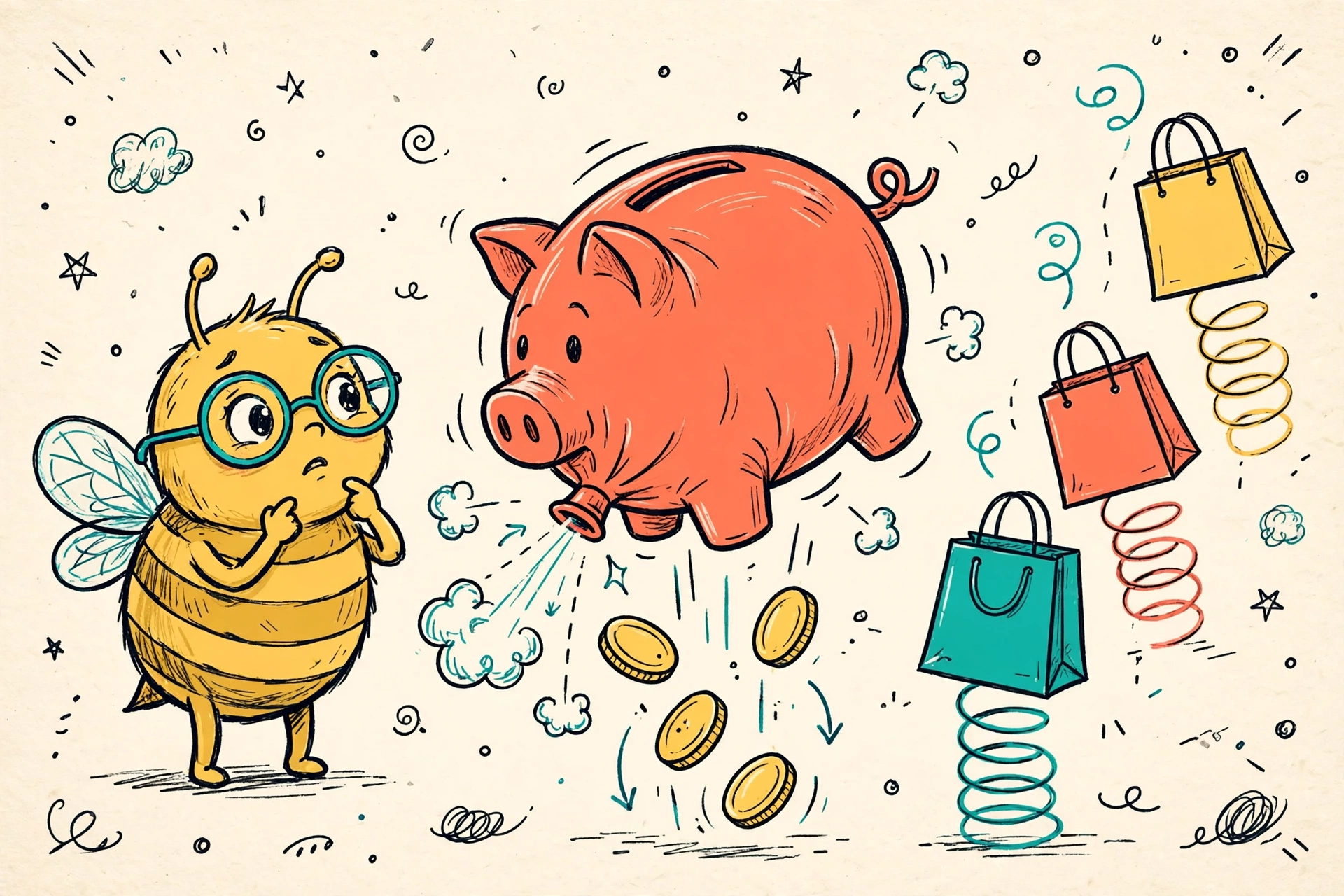
Inflation is why the cash sitting in your savings account buys a little less every year. Prices creep up across the economy — groceries, rent, haircuts, insurance — so each dollar in your account stretches a bit less than it did last year. Your balance doesn’t drop. What it can buy does, and that’s the part that stings.
A tiny example that makes it click
Say a basket of everyday stuff costs $100 this year. If prices rise 3% over the next year, that same basket costs $103. Nothing about the basket changed. You didn’t get more bread or better coffee. You just need three extra dollars to stand still.
Now flip it around. You’ve got $1,000 tucked in an account that pays almost nothing. A year of 3% inflation later, your statement still says $1,000 — but it buys what about $970 bought before. You lost ground without spending a cent. Dot put it bluntly when we walked through this: “So my money can shrink while it’s sitting still?” Yep. That’s exactly it.
How inflation gets measured
In the US, the headline number you’ll hear on the news comes from the Consumer Price Index, or CPI, published by the Bureau of Labor Statistics. Trackers price a big basket of goods and services every month — food, housing, gas, medical care, the lot — and report how much the total moved.
A few quirks are worth knowing. The CPI is an average, and your life isn’t average. If you rent and rents in your city jumped 6%, your personal inflation feels hotter than a headline rate of 3%. If you own your home outright and drive an old paid-off car, yours might feel cooler. Headline inflation is a weather report for the whole country. Your budget lives in one town.
You’ll also hear about “core” inflation, which strips out food and energy because those prices swing wildly month to month. It’s useful for spotting trends. It won’t match your grocery bill, and it’s not supposed to.
What actually causes prices to rise?
Economists argue about the mix, but the usual suspects show up again and again:
- Demand runs ahead of supply. Lots of buyers chasing too few homes, cars or concert tickets bid prices up.
- Costs rise for businesses. When wages, fuel or raw materials get pricier, some of that lands in the final price you pay.
- Supply gets squeezed. A drought, a factory fire or a shipping jam means less stuff on shelves, and scarce stuff costs more.
- Money and credit expand fast. When borrowing is cheap and plentiful for a long stretch, spending power grows faster than the goods it chases.
Most years it’s a blend. A bit of this, a bit of that. The clean single-cause story you see in headlines is usually too clean.
The Federal Reserve’s 2% target, in plain English
The Federal Reserve aims for inflation of about 2% a year over time, measured by a related index called PCE. Why not zero? A little inflation gives the Fed room to cut interest rates in a slump, and it keeps the economy away from deflation — falling prices — which sounds nice but can freeze spending, since why buy today if it’ll be cheaper next month?
When inflation runs well above target, the Fed raises interest rates to cool borrowing and spending. When it falls too low, rates come down. That’s why inflation reports move markets, mortgage rates and the APY on your savings account, sometimes within the same afternoon.
What inflation does to your savings, year by year
Here’s the slow leak, in numbers. Park $10,000 in cash and assume prices rise 3% a year, a touch above the Fed’s target:
- After 1 year, your $10,000 buys what about $9,709 buys today.
- After 5 years, it’s down to roughly $8,626 of today’s buying power.
- After 10 years, about $7,441. You’ve “lost” a quarter of what your money can do, and you never made a bad purchase.
Cash under a mattress is the extreme case, but a checking account paying 0.01% isn’t far off. The account isn’t broken. It’s just not keeping pace, and the gap compounds quietly in the wrong direction.
Nominal return vs. real return: the only math that matters here
Your account’s stated rate is the nominal return. Subtract inflation and you get the real return — what your buying power actually did. Savings account paying 4% while inflation runs at 3%? Your real return is about 1%. Money market paying 0.5% against 3% inflation? You’re going backwards at roughly 2.5% a year, in buying-power terms, no matter what the balance says.
That one subtraction changes how you read every rate you’re offered. A “high” rate in a hot-inflation year might buy you nothing. A modest rate in a calm year might be doing fine.
Want to see it with your own numbers? Plug a balance, a rate and a few years into the Compound Interest Calculator, then compare the result against what prices rising 2–3% a year would do to the same pile. The gap between the two lines is your real return at work.
Practical ways people protect their buying power
You can’t opt out of inflation. You can refuse to let idle cash take the full hit:
- Don’t hoard cash beyond your emergency fund. Three to six months of expenses in savings is a shield. Three years of expenses sitting in checking is a slow leak.
- Move idle savings to a higher APY. High-yield savings accounts won’t beat inflation every year, but they narrow the gap a lot compared with a big bank’s 0.01%.
- Let long-term money work harder. Money you won’t touch for a decade or more is the money people typically invest, accepting ups and downs in exchange for a shot at returns above inflation over long stretches. Short-term money doesn’t belong there — a dip right when you need the cash is its own kind of loss.
- Grow the income side too. Raises, skills and side income that keep pace with prices defend your standard of living in a way no account can.
- Watch your fixed debts — there’s a small silver lining. A fixed-rate mortgage payment stays the same in dollars while prices and (often) wages rise around it, so it gets a little easier to carry over time. Inflation is rough on savers in cash, gentler on people who owe fixed payments.
Don’t overcorrect, either
Every few years inflation spikes and the hot takes arrive: cash is trash, buy this, dump that. Slow down. Inflation at 3% is a leak to manage, not a fire to flee. The folks who get hurt worst usually swing between extremes — all cash for a decade, then all-in on whatever a cousin recommended at the peak. A boring setup beats both: a real emergency fund, idle savings earning a decent APY, long-term money invested on a schedule you can stick with, and a yearly look at whether your pay kept up.
Frequently asked questions
Is some inflation actually normal?
Yes. Prices in the US have risen in most years for decades, and the Federal Reserve targets about 2% a year on purpose. Mild, steady inflation is the background hum of a growing economy. It’s fast or unpredictable inflation that causes the real damage.
Who wins and who loses when inflation rises?
People holding lots of cash and people on fixed incomes lose buying power fastest. Borrowers with fixed-rate loans gain a little, because they repay in cheaper dollars. It’s not fair or unfair by design — it’s just how the math shakes out, and it’s why where you keep money matters.
Does inflation affect my savings account interest rate?
Indirectly, yes. When the Fed raises rates to fight inflation, banks usually raise savings APYs too, though big banks often move slowly. When inflation cools and rates fall, APYs drift down. Your real return is always the APY minus inflation, whatever the headline says.
What’s the difference between inflation and deflation?
Inflation is prices rising overall; deflation is prices falling overall. Deflation sounds like a bargain, but it can stall an economy — people delay buying, businesses cut back, debts get heavier in real terms. Central banks fear it more than mild inflation.
How fast does money lose half its value at 3% inflation?
Roughly 23–24 years. Divide 72 by the inflation rate and you get the doubling time for prices — which is the halving time for your cash’s buying power. At 2% it’s about 36 years; at 5%, closer to 14. Slow, but relentless.
Dot Wealthy is an education site, not a financial adviser. Inflation figures and rates change over time — check current CPI data at bls.gov and current account rates before you act, and talk to a qualified professional before making big money decisions.
This article was created with AI assistance and reviewed by our editorial team before publishing.