
How Federal Income Tax Brackets Actually Work

In short: Your income is taxed in layers. The 10% rate applies only to the first slice of taxable income, 12% to the next slice, and so on. Being “in the 22% bracket” means only the dollars above the 22% threshold are taxed at 22% — everything below is taxed at lower rates. Nobody pays their bracket rate on their whole income.
Dot nearly threw her laptop when she saw it. Her new salary pushed her past $50,000, and she was convinced her entire paycheck would now be taxed at 22%. “So a raise actually makes me poorer?” she asked.
Wealthy shook his head and pulled out a napkin. “Only the dollars above the line pay the higher rate. The rest keep the old rate. That’s the whole trick — and it’s the most misunderstood idea in American taxes.”
He’s right. The confusion costs real people real money: turned-down raises, skipped promotions, and a lot of unnecessary anxiety. Here’s how the system actually works.
The one idea that changes everything
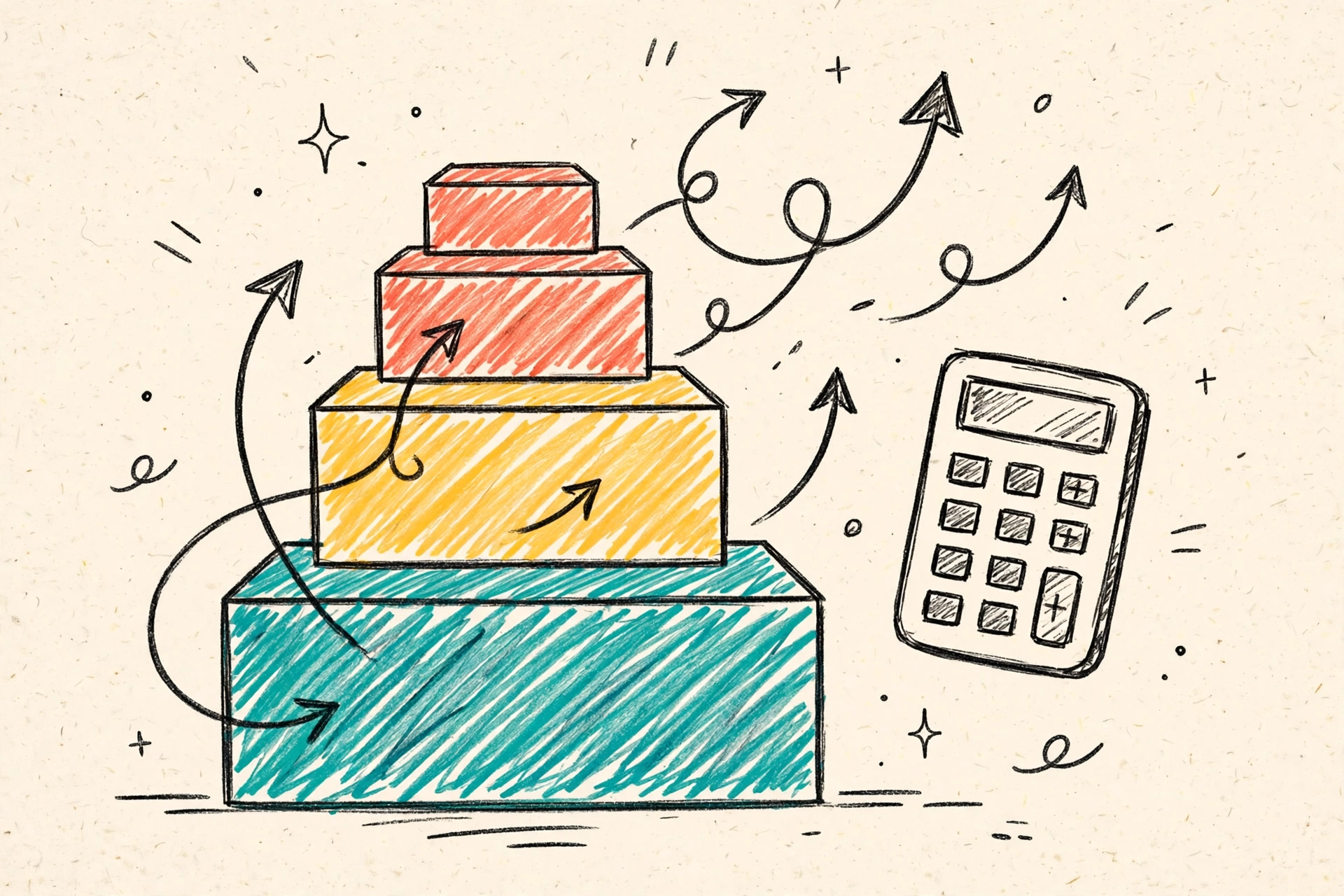
Federal income tax is marginal. Picture a stack of buckets. Your first dollars of taxable income fill the 10% bucket. Once it’s full, the overflow pours into the 12% bucket, then the 22% bucket, and so on. Each dollar is taxed at the rate of the bucket it lands in.
That’s it. There is no cliff. Moving into a higher bracket never makes your whole income taxed at the higher rate.
A worked example: $60,000 of taxable income
Let’s run the numbers for a single filer with $60,000 of taxable income, using the official 2026 brackets announced by the IRS (Rev. Proc. 2025-32).
| Income layer | Rate | Tax owed |
|---|---|---|
| First $12,400 | 10% | $1,240 |
| $12,400 – $50,400 ($38,000) | 12% | $4,560 |
| $50,400 – $60,000 ($9,600) | 22% | $2,112 |
| Total federal income tax | $7,912 |
The total is $7,912. On $60,000 of taxable income, that’s an effective rate of about 13.2% — even though this person is “in the 22% bracket.” The 22% applied to just $9,600 of their income.
Dot stared at the napkin. “So my raise isn’t cursed after all.”
Marginal rate vs. effective rate
Two numbers, two jobs:
- Marginal rate — the rate on your last dollar of income. In the example above: 22%. It answers “how is my next dollar taxed?”
- Effective rate — your total tax divided by your total taxable income. In the example: ~13.2%. It answers “what share did I actually pay?”

When people say “my tax rate,” they usually mix the two up. Your marginal rate is the one that matters for decisions — like whether extra work hours or a year-end bonus are worth it. Your effective rate is the one that tells you how heavy the overall load felt.
The 2026 federal tax brackets
For 2026, the IRS kept the same seven rates it has used in recent years — 10%, 12%, 22%, 24%, 32%, 35%, and 37% — but raised the income thresholds by roughly 2.8% on average to keep up with inflation, according to the IRS inflation-adjustment announcement (Rev. Proc. 2025-32).
Single filers, 2026
| Taxable income | Rate |
|---|---|
| $0 – $12,400 | 10% |
| $12,400 – $50,400 | 12% |
| $50,400 – $105,700 | 22% |
| $105,700 – $201,775 | 24% |
| $201,775 – $256,225 | 32% |
| $256,225 – $640,600 | 35% |
| Over $640,600 | 37% |
Married filing jointly, 2026
| Taxable income | Rate |
|---|---|
| $0 – $24,800 | 10% |
| $24,800 – $100,800 | 12% |
| $100,800 – $211,400 | 22% |
| $211,400 – $403,550 | 24% |
| $403,550 – $512,450 | 32% |
| $512,450 – $768,700 | 35% |
| Over $768,700 | 37% |
A note that matters: these brackets apply to taxable income, not your salary. Your taxable income is what’s left after subtracting deductions. A reminder: these figures cover tax year 2026 — the return you file in spring 2027.
Before the brackets: the standard deduction
The brackets don’t touch your first dollars of income at all, because of the standard deduction. For 2026, it’s $16,100 for single filers, $32,200 for married couples filing jointly, and $24,150 for heads of household, per the same IRS announcement.
So a single person earning $60,000 in wages who takes the standard deduction has $43,900 of taxable income ($60,000 − $16,100) — and the bracket math starts from there. That’s why many people are surprised at tax time: the brackets apply to a smaller number than their paycheck suggested.
Three mistakes almost everyone makes
Mistake 1: “A raise pushed me into a higher bracket, so I’ll take home less.”
Impossible under a marginal system. Only the dollars above the new threshold are taxed at the higher rate. A raise always increases your take-home pay — though a smaller share of each extra dollar goes home than before.
Mistake 2: “I’m in the 22% bracket, so I pay 22% tax.”
Our $60,000 example paid an effective rate of ~13.2%. The bracket is the rate on the margin, not the average. If someone tells you their “tax rate” and it sounds high, they’re usually quoting the marginal one.
Mistake 3: “Bracket math covers my whole tax bill.”
Brackets apply to ordinary income. Capital gains, dividends, Social Security benefits, and self-employment tax follow different rules. And this is all federal — state taxes are a separate layer entirely.
What your marginal rate is actually useful for
Your marginal rate is a planning tool, not a punishment. It tells you what an extra dollar of income costs in tax — which is the right number to have in mind when you’re deciding things like:
- Whether to contribute to a traditional (pre-tax) retirement account, where contributions are deducted at your marginal rate
- How much of a year-end bonus you’ll actually keep
- Whether selling an asset this year or next changes the tax math
These are general concepts, not personal advice — everyone’s situation has wrinkles. The point is simpler: knowing your marginal rate turns a vague fear of “taxes” into a concrete number you can plan around.
Why the brackets move every year
Left alone, inflation would quietly push everyone into higher brackets — a raise that only matches rising prices would get taxed harder, even though your buying power didn’t change. Economists call that bracket creep.
To prevent it, the IRS adjusts bracket thresholds for inflation each year. The 2026 thresholds rose about 2.8% on average, which is why someone earning the same salary in 2025 and 2026 can owe slightly less federal tax in 2026 — the same income lands in slightly wider lower-rate buckets.
Your withholding is not your tax bill

Every payday, your employer withholds an estimate of your taxes based on your W-4 form and IRS tables. A big refund isn’t a bonus — it’s the IRS returning money you overpaid during the year. Owing money in April doesn’t mean you did anything wrong either — it means your withholding ran a little short.
If your life changes — a new job, a spouse, a side gig — updating your W-4 keeps the estimate honest. A huge refund means you gave the government an interest-free loan; a huge bill means you might owe a penalty for underpaying. Small adjustments beat April surprises.
One more layer: state taxes
Everything above is federal. Your state runs its own system — some states use graduated brackets like the federal system, some use a single flat rate, and some have no income tax at all. State rules change your real take-home number, so treat the federal math as one layer of the full picture, not the whole picture.
Frequently asked questions
Does moving into a higher tax bracket mean I lose money?
No. Because brackets are marginal, only the income above the threshold is taxed at the higher rate. Your take-home pay always goes up when your income goes up — never down.
What is the difference between marginal and effective tax rate?
Your marginal rate is the tax on your last dollar of income (for example, 22%). Your effective rate is your total tax divided by your total taxable income (for example, ~13.2% on $60,000 for a single filer). The effective rate is always lower than the marginal rate when you span multiple brackets.
What are the 2026 federal tax brackets?
The seven rates are 10%, 12%, 22%, 24%, 32%, 35%, and 37%, per the IRS announcement (Rev. Proc. 2025-32). For single filers, the 10% rate covers taxable income up to $12,400 and the 37% rate starts above $640,600. For married couples filing jointly, the thresholds are $24,800 and $768,700.
Do tax brackets apply to my whole salary?
No — they apply to taxable income, which is your income minus deductions. With the 2026 standard deduction ($16,100 single, $32,200 married filing jointly), a large part of many people’s earnings is never touched by any bracket.
Why do tax bracket thresholds change every year?
The IRS adjusts thresholds for inflation to prevent “bracket creep” — where cost-of-living raises push people into higher brackets even though their real purchasing power didn’t grow. The 2026 thresholds rose about 2.8% on average.
For education only, not financial advice.