
Tax Deductions vs. Tax Credits, Explained Simply
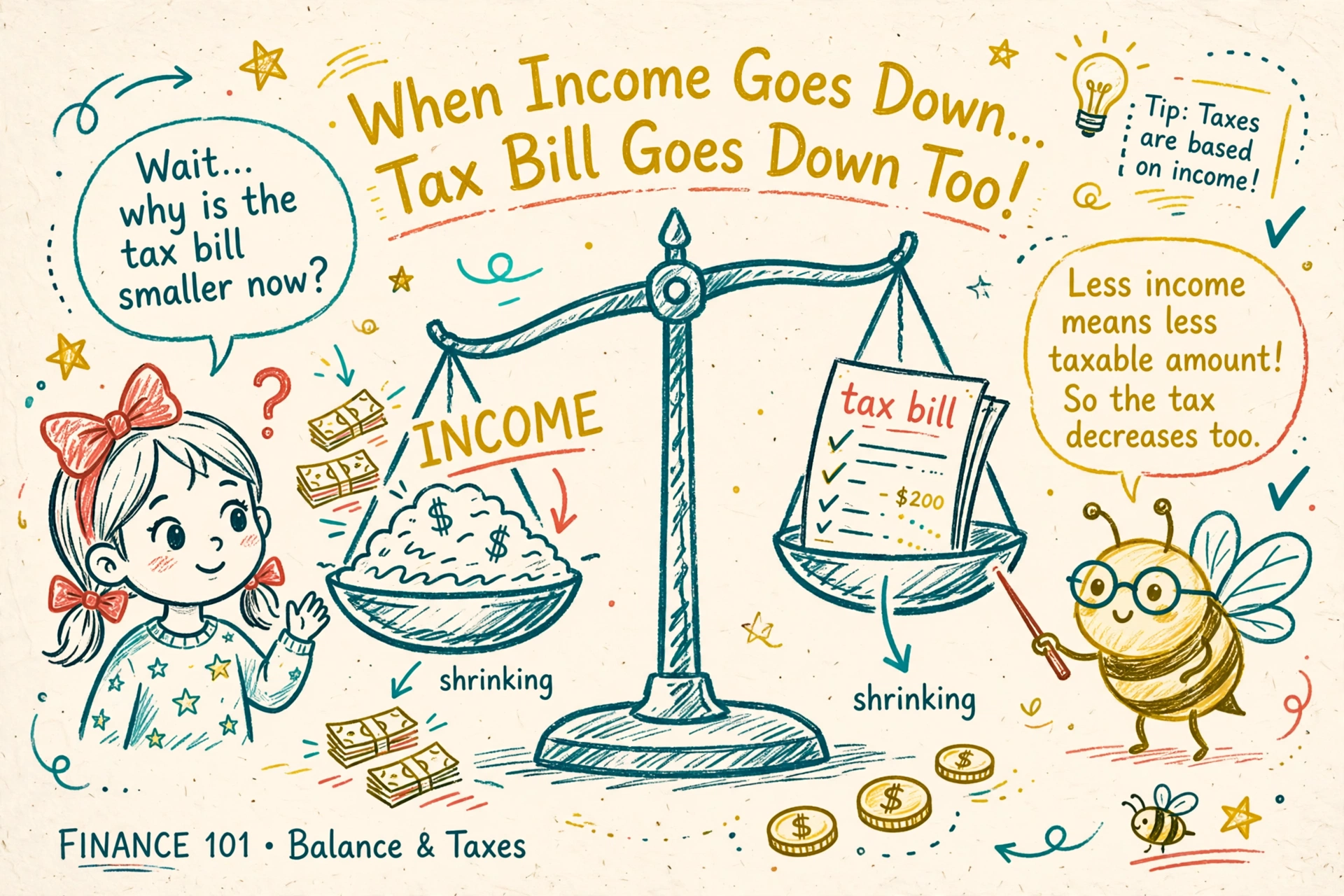
In short: A tax deduction shrinks the income the IRS taxes you on, so its value depends on your tax bracket. A tax credit shrinks the tax bill itself, dollar for dollar. That is why a $1,000 credit beats a $1,000 deduction every single time, and why mixing the two up can quietly cost you real money.
Dot had both words circled on the same page of her notebook. Twice.
“They sound like the same thing,” she said. “Deduction. Credit. Either way I pay less, right?”
“Either way you pay less, yes,” Wealthy said. “But one of them whispers and the other one shouts. Want to guess which is which before we do the math?”
She guessed wrong. Most people do. Here is the plain version, with numbers, so you don’t have to guess at all next April.
Two different levers, two different moments
Picture your tax return as a short hallway with two doors.
Behind the first door, the IRS works out how much of your income gets taxed. Deductions live here. Every deduction you claim makes that pile of taxable income a little smaller before anyone picks a tax rate.
Behind the second door, your tax bill already exists. It’s a real number now. Credits live here, and they chip pieces straight off that number. No rate math. No percentages. A dollar of credit is a dollar off the bill.
So the order matters. Deductions act early, on income. Credits act late, on the bill itself. Keep that hallway in your head and the rest of this page gets easy.
What a deduction is really worth to you
Here’s where people get tripped up. A deduction feels bigger than it is.
Say you’re in the 22% marginal bracket. That’s a common spot for a single filer with a solid middle income. You claim a $1,000 deduction. Did you just save $1,000?
Nope. You saved $220.
Why? Because the deduction didn’t touch your bill. It touched your taxable income. You now get taxed on $1,000 less, and 22% of $1,000 is $220. That’s your saving. Real money, sure. Just not the headline number.

Drop into the 12% bracket and that same $1,000 deduction saves you $120. Land in the 32% bracket and it saves $320. Same deduction, three different values. The deduction didn’t change. You did.
Now, the deduction almost everyone meets first: the standard deduction. It’s a flat amount the IRS lets you subtract from your income with zero receipts and zero itemizing, according to the IRS. For tax year 2025, it’s $15,750 if you file single and $31,500 if you’re married filing jointly, according to the IRS. For tax year 2026, those amounts rise to $16,100 single, $32,200 married filing jointly, and $24,150 for heads of household.
The alternative is itemizing, where you add up specific deductible expenses instead. Common ones include:
- Mortgage interest on your main home
- State and local taxes, subject to the cap in current law
- Charitable donations to qualifying organizations
- Some medical expenses, once they pass the IRS threshold for deductibility
The rule of thumb is blunt. If your itemized total beats the standard deduction, itemize. If it doesn’t, take the standard amount and don’t feel guilty about it. There’s no prize for doing extra paperwork that pays you less.
Why a credit hits so much harder
Credits skip the bracket math entirely.
A $1,000 credit takes $1,000 off your tax bill. Full stop. It doesn’t care if you’re in the 12% bracket or the 32% bracket. It doesn’t shrink when your income dips. Dollar for dollar means exactly what it sounds like.
Put the two side by side, at that same 22% bracket:
| You claim | What it lowers | What you actually save |
|---|---|---|
| $1,000 deduction | Your taxable income | About $220 |
| $1,000 credit | Your tax bill | The full $1,000 |

Dot stared at that table for a second. “So why does anyone chase deductions at all?”
Two reasons. First, you can claim both, and most filers do. Second, some credits are hard to qualify for. They come with income limits, paperwork, and very specific rules about who counts. A deduction you actually qualify for beats a credit you don’t, every time.
Refundable or not: the split inside credits
Not all credits play by the same rules, and this part changes real outcomes.
A nonrefundable credit can drag your tax bill down to zero and then it stops. Owe $800 and hold a $1,000 nonrefundable credit? Your bill becomes zero. The other $200? Gone. It doesn’t carry into your refund.
A refundable credit keeps going. It can push your bill below zero, and the IRS sends you the difference as a refund, according to the IRS. That’s how someone with a small tax bill can still get money back at filing time.
Some credits sit in between. Part refundable, part not. Annoying? A little. But once you know the split exists, you’ll never read a credit’s headline number the same way again. Always ask which kind it is.
The names you’ll actually run into
You don’t need a wall of tax code here. Just the greatest hits, sorted by which lever they pull.
Credits people commonly claim:
- Child Tax Credit — worth up to $2,200 per qualifying child for tax year 2025, according to the IRS, with up to $1,700 of it potentially refundable.
- American Opportunity Tax Credit — up to $2,500 per eligible student for qualified education expenses, according to the IRS, with up to 40% of it refundable.
- Earned Income Tax Credit — a refundable credit for low- to moderate-income workers, according to the IRS. Plenty of eligible people skip it simply because they assume they earn too much or too little. Don’t assume. Check.
- Child and Dependent Care Credit — a nonrefundable credit tied to care costs that let you work.
Deductions people commonly claim:
- Student loan interest — you can deduct up to $2,500 of interest you paid, according to the IRS, and you don’t need to itemize to claim it.
- Traditional IRA and workplace plan contributions — these can lower your taxable income, subject to the rules and limits the IRS sets for your situation.
- Health savings account contributions — deductible if you qualify under IRS rules for your health plan.
- The standard deduction itself — yes, it counts. It’s the deduction most filers actually use.

Notice something? The credits cluster around family, school, and lower incomes. The deductions cluster around housing, giving, and saving for later. That’s not an accident. Tax breaks are policy with a price tag, and the price tag tells you what the policy wants more of.
Three questions that sort any tax break
Next time someone pitches you a tax break — a coworker, a video, a very confident uncle — run it through these three questions before you get excited.
- Is it a deduction or a credit? If it’s a deduction, multiply by your bracket before you celebrate. That product is your real saving.
- If it’s a credit, is it refundable? A nonrefundable credit is worth nothing past the size of your bill. Size your expectations to your actual tax, not the headline.
- Do you actually qualify? Income limits and filing rules knock out more claims than any other factor. Read the IRS page for that specific break. It takes five minutes and saves real regret.
Wealthy’s version is shorter. “Ask what it lowers, then ask what it’s worth to you. In that order.”
He’s not wrong. A break that lowers income is a percentage game. A break that lowers the bill is a subtraction. Know which game you’re playing and the numbers stop lying to you.
Frequently asked questions
Can you claim both deductions and credits on the same return?
Yes. Most people do. You take your deductions first, which lowers your taxable income, and then you apply any credits you qualify for to the tax bill that is left, according to the IRS order of operations on Form 1040. One does not cancel out the other.
Which is worth more, a $1,000 deduction or a $1,000 credit?
The credit, and it is not close. A credit cuts your tax bill by the full $1,000. A deduction cuts your taxable income by $1,000, so at a 22% marginal rate it saves you about $220. The lower your bracket, the smaller a deduction gets, while a credit stays the same size.
What does refundable mean for a tax credit?
A refundable credit can push your tax bill below zero and pay you the rest back as a refund, according to the IRS. A nonrefundable credit can only bring your bill down to zero. Any leftover amount from a nonrefundable credit is gone, unless that specific credit allows a carryforward.
Should I itemize or take the standard deduction?
Add up your itemized deductions first. If the total beats the standard deduction for your filing status, itemizing usually wins. For tax year 2025, the standard deduction is $15,750 for single filers and $31,500 for married couples filing jointly, according to the IRS. For tax year 2026, the amounts are $16,100 single and $32,200 married filing jointly. If your itemized total falls short of that, take the standard deduction and move on.
For education only, not financial advice. Everyone’s money situation is different — when in doubt, talk to a qualified financial professional or tax advisor.
This article was created with AI assistance and reviewed by our editorial team before publishing.