
How to Budget When Your Income Changes Every Month
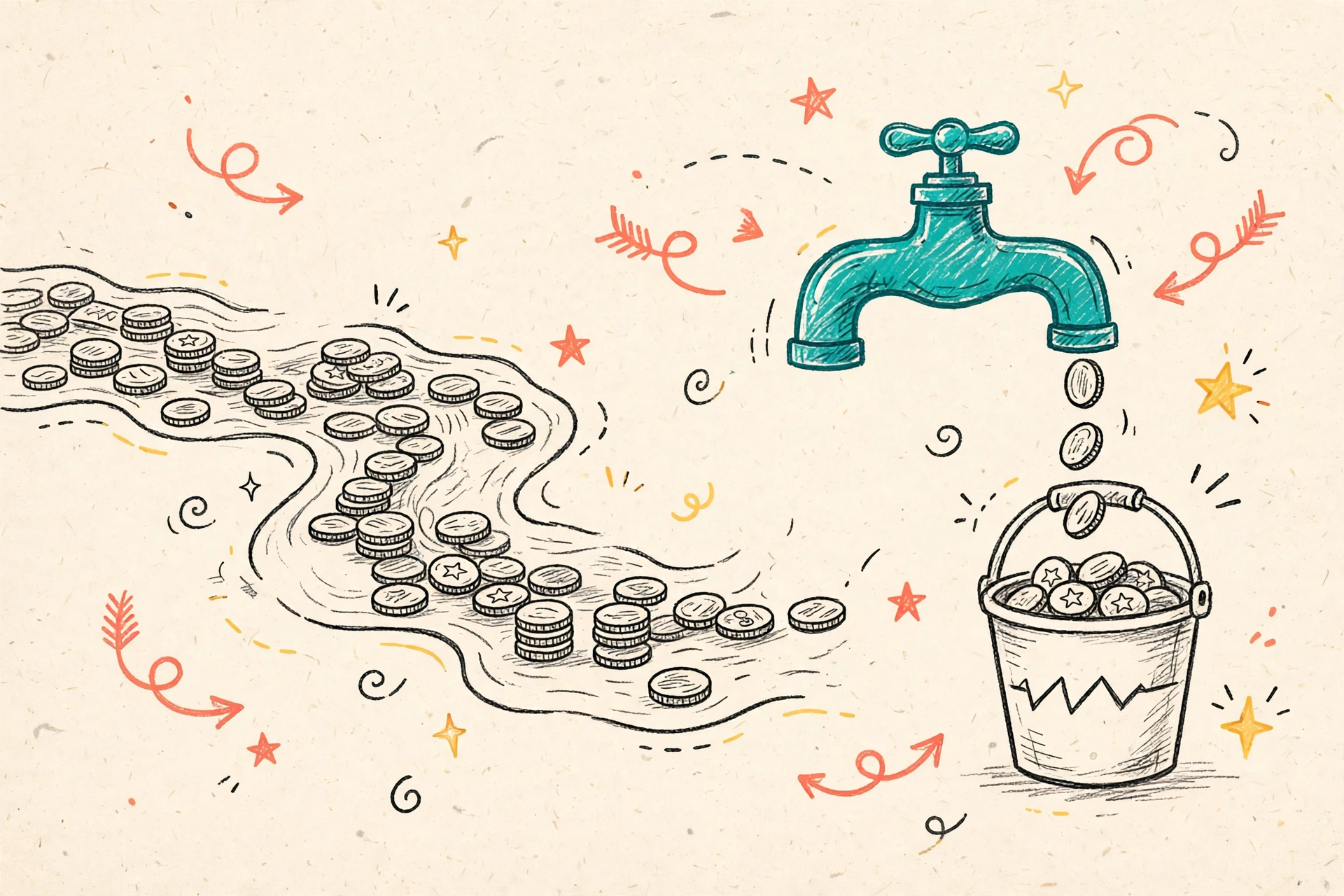
In short: Start with a number you can trust: your average monthly income over the last 6 to 12 months — or your worst recent month, if you’d rather play it safe. Pay yourself a fixed “salary” from that number, move 25–30% of every payment into a tax bucket if you’re self-employed, and stack up a two- to three-month buffer so a lean month never becomes a crisis.
Dot freelanced as a graphic designer for two years before she admitted the truth: “I don’t budget. I just… react.” Her words, not mine. Some months she landed $6,000 in projects and felt like a genius. Other months she made $1,800 and ate rice for the last week.
“The problem isn’t your income,” Wealthy told her. “The problem is you’re trying to spend from a river. You need to turn it into a faucet.”
He’s onto something. A steady paycheck hands you a budget for free. An uneven one doesn’t — so you have to build the steady part yourself. Here’s how.
Your floor matters more than your average
Most budgeting advice starts with “figure out your monthly income.” For a freelancer, a gig driver, a server who lives on tips, that’s a trick question. Your monthly income isn’t a number. It’s a range.
So here’s what actually works: look back at your last six to twelve months of pay. Add it up, divide, and you get your average. That’s useful — it tells you what you’re capable of earning. But don’t budget from it.
Budget from your floor: the worst month in that stretch (or close to it). If your months ranged from $2,100 to $5,800 and averaged $3,600, plan your essential spending around something near that $2,100. The gap between the floor and the average? That’s not spending money. That’s buffer money, tax money, goal money. More on all three below.
Why the floor and not the average? Because averages lie in exactly one direction: up. Half your months will come in below it. If your rent, groceries, and insurance are sized for the average, you’ll feel broke almost half the year. Sized for the floor, you’ll feel fine nearly all of it. That’s not pessimism. That’s arithmetic.
Pay yourself a salary
This is the single biggest mindset shift, and it’s deceptively simple. All your income goes into one holding account. Then, on the same day every month (or every two weeks — pick a rhythm and keep it), you pay yourself a fixed amount. Same number, every time.
Let’s say your floor math says you can count on about $3,000. Your salary is $3,000. Every month. Period.
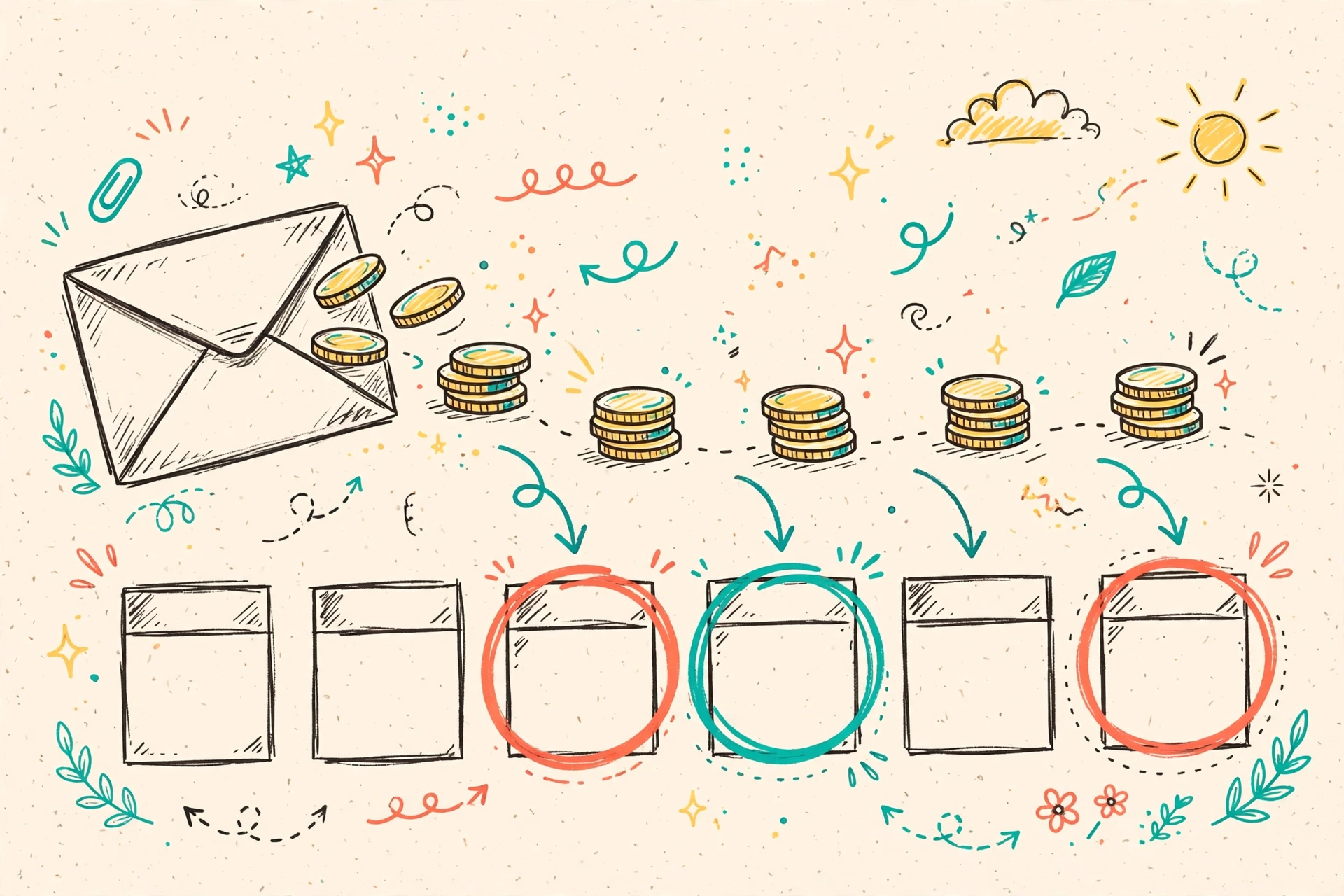
In a $5,000 month, you don’t get a raise. The extra $2,000 goes to its assigned jobs — taxes, buffer, savings — before you touch a dime. In a $1,800 month, you don’t take a pay cut either. The buffer covers the gap.
Dot tried this for the first time in January. “It felt like getting a job with myself as the boss,” she said. “The boss is strict, but at least she pays on time.”
How do you pick the salary number? Add up your essential monthly costs — rent, utilities, groceries, transport, insurance, minimum debt payments — and start there. If essentials are $2,600, a $2,800 salary gives you breathing room without fantasy. You can always raise your “salary” later, when the buffer is fat and the trend is your friend. Give it at least three or four months first.
Don’t forget the tax bite
This one ruins people. If you’re an employee, your employer quietly sends part of every paycheck to the IRS for you. If you’re self-employed, that job is yours — and the bill is bigger than most beginners expect.
Here’s why: self-employed workers pay both halves of the payroll taxes that employees split with their employer. On top of ordinary income tax, there’s the self-employment tax — 15.3% for Social Security and Medicare under IRS rules. Stack the two together, and a simple rule of thumb from tax planners is to set aside 25–30% of every payment you receive, before you spend a cent.
Twenty-five to thirty percent of net income, every invoice, every deposit. Move it into a separate savings account the day the money arrives. Not the end of the month. The day it arrives. Money that sits in checking gets spent; money parked in a boring savings account survives until April.
“But 30% of a small check feels brutal,” Dot protested. Wealthy shrugged. “So does a $4,000 tax bill you can’t pay.”
Is 25–30% more than you’ll actually owe? Maybe. Some people in lower brackets owe less. But the rule exists because the most common tax disaster in freelance life isn’t owing a little too much — it’s owing nothing all year and then getting blindsided. A small over-reserve you discover at tax time is a refund. An under-reserve is a debt. Easy choice.
Build a buffer (your real superpower)
A buffer is money with one job: covering your fixed “salary” when income runs dry. Two to three months of essential expenses, parked in a separate account, doing nothing but standing by.
Start small. Even $500 of buffer changes how a thin month feels. Then keep feeding it from every good month — make it the first destination for surplus money, before lifestyle upgrades. A good target, echoed by budgeting apps like YNAB and personal finance writers alike, is the point where you can live on last month’s income: spend in May what you earned in April. When you get there, the chaos of irregular pay stops touching your daily life. Your spending runs on rails.
Dot’s buffer took eleven months to fill. “Month four I almost quit,” she admitted. “Then a client ghosted in September and I just… kept living. Same groceries. Same rent paid on time. That was the first time money felt boring, and boring was wonderful.”
One more thing: name the account. Literally give it a nickname at your bank — “Salary Fund” or “Short Month Fund” or whatever makes it feel sacred. Silly? Sure. It also works. You’re much less likely to raid an account with a name than one labeled “Savings.”
A priority list for the weeks it gets thin
Even with a salary system, some weeks will feel tight. Keep a short written list of your expenses in three tiers:
- Must-haves: rent, utilities, groceries, transport, insurance, minimum debt payments. These get paid no matter what.
- Nice-to-haves: streaming, dining out, new clothes. Fine in good months, first on the chopping block in tight ones.
- Can wait: vacations, big purchases, upgrades. These get a calendar date, not a credit card.

Why write it down? Because decisions made during a panic are terrible. When a slow month hits and you’re staring at your bank app at midnight, you shouldn’t be deciding what counts as essential. Past-you already decided. Trust past-you.
Review quarterly, adjust annually
Monthly budget reviews assume monthly patterns. You don’t have those. Check in quarterly instead: every three months, look at actual income, actual spending, buffer level, and tax set-asides. Three questions, honest answers:
- Is my salary still realistic, or has my floor moved?
- Is the buffer growing, flat, or shrinking?
- Am I setting aside enough for taxes, based on what I actually earned?
If the buffer is shrinking three quarters in a row, your salary is too high for your real income — cut it before the buffer hits zero. If the buffer is fat and growing, consider raising the salary or pointing the surplus at a goal: debt, retirement, a real emergency fund.
And don’t confuse the buffer with an emergency fund. The buffer covers predictable dry spells — it’s a cash-flow tool. The emergency fund (three to six months of expenses, per most financial planners) covers unpredictable disasters: the car dying, the medical bill. Ideally you build both. If you can only build one right now, start with the buffer — it attacks the problem you actually have every month.

The quick version
If this is the first money article you’ve ever finished (nice work, by the way), here’s the whole system on one napkin:
- Find your floor. Worst recent month = your budget base.
- Pay yourself a salary. Fixed amount, fixed schedule, from the holding account.
- Tax first. Move 25–30% of every payment to a separate account if you’re self-employed.
- Feed the buffer. Two to three months of essentials, then keep spending boring.
- Review quarterly. Three questions, honest answers, adjust the salary if the numbers say so.
Irregular income isn’t a curse. It’s just income that hasn’t been organized yet. Build the system once, and every month after that feels — finally — normal.
Frequently asked questions
What’s the best budgeting method for irregular income?
Budget from your lowest recent month, not your average. Give every dollar a job the moment it arrives (zero-based budgeting), route all income through a holding account, and pay yourself a fixed salary. Surplus months fill your tax bucket and buffer; lean months draw from the buffer — not credit cards.
How much should I set aside for taxes as a freelancer?
A common rule of thumb is 25–30% of every payment, moved to a separate account the day it arrives. This covers self-employment tax (15.3% for Social Security and Medicare per IRS rules) plus federal and state income tax. You may owe less depending on your bracket — but over-saving beats a surprise tax bill.
Should I budget from my average income or my lowest month?
Your lowest recent month. Half of all months will come in below your average, so budgeting from the average leaves you short about half the year. Plan essentials around the floor; treat everything above it as bonus money with pre-assigned jobs.
How big should my income buffer be?
Two to three months of essential expenses is a solid target. That’s enough to pay yourself the same salary through a dry spell without touching savings or debt. Start with whatever you can — even $500 of buffer takes the panic out of a thin month.
Is a buffer the same as an emergency fund?
No. A buffer smooths predictable income swings — it’s a cash-flow tool for uneven pay. An emergency fund covers unpredictable disasters like car repairs or medical bills (financial planners typically suggest three to six months of expenses). Build the buffer first; it fights the problem you have every month.
For education only, not financial advice. Everyone’s money situation is different — when in doubt, talk to a qualified financial professional or tax advisor.