
Compound Interest, Explained Simply
Albert Einstein reportedly called compound interest the eighth wonder of the world. He probably didn’t — the quote is almost certainly apocryphal — but the sentiment survives because it’s true. Compound interest is the closest thing to magic in personal finance: growth that builds on its own growth, quietly turning small, boring contributions into life-changing sums over time.
If you understand exactly one investing concept, make it this one. Everything else — retirement accounts, index funds, asset allocation — is just a vehicle for putting compound interest to work.
What Compound Interest Actually Means
Simple interest pays you only on your original amount. Compound interest pays you on your original amount plus everything it has already earned. That one-word difference changes everything.

Imagine you put $1,000 somewhere earning 10% a year. With simple interest, you’d earn $100 every year — $1,000 after ten years, for a total of $2,000. With compound interest, year one earns $100 (balance: $1,100), but year two earns 10% of $1,100 — that’s $110. Year three earns $121. Each year’s earnings become next year’s principal. After ten years you have about $2,594, not $2,000. After twenty years, about $6,727 — versus $3,000 with simple interest.
The gap starts small and then explodes. That explosion is the whole story of long-term wealth building: not brilliant stock picks, not timing the market — just returns compounding on returns, year after year.
The Rule of 72: Doubling Time in Your Head
The Rule of 72 is a mental shortcut for one question: how long until my money doubles? Divide 72 by your annual rate of return, and that’s roughly how many years it takes.
- At 7% annual return: 72 ÷ 7 ≈ 10.3 years to double.
- At 10%: 72 ÷ 10 ≈ 7.2 years to double.
- At 3% (a typical savings account in a good year): 72 ÷ 3 = 24 years to double.
It works in reverse, too — for inflation. At 3% inflation, the purchasing power of your cash halves in about 24 years. That’s why money sitting in a low-interest checking account isn’t “safe” in the long run; it’s slowly shrinking in real terms. This is also why your emergency fund belongs in a high-yield account, not a drawer — though safety, not growth, is still its job.
A Worked Example: $200 a Month at 7%
Let’s make this concrete. Suppose you invest $200 a month — $2,400 a year — and earn an average annual return of 7%, roughly in line with the long-term historical average of a diversified US stock portfolio after inflation adjustments are set aside. (Actual market returns vary wildly year to year; 7% is a planning assumption, not a promise.)
- After 10 years: you’ve contributed $24,000; the account holds about $34,900.
- After 20 years: contributed $48,000; the account holds about $104,700.
- After 30 years: contributed $72,000; the account holds about $243,900.
- After 40 years: contributed $96,000; the account holds about $525,300.
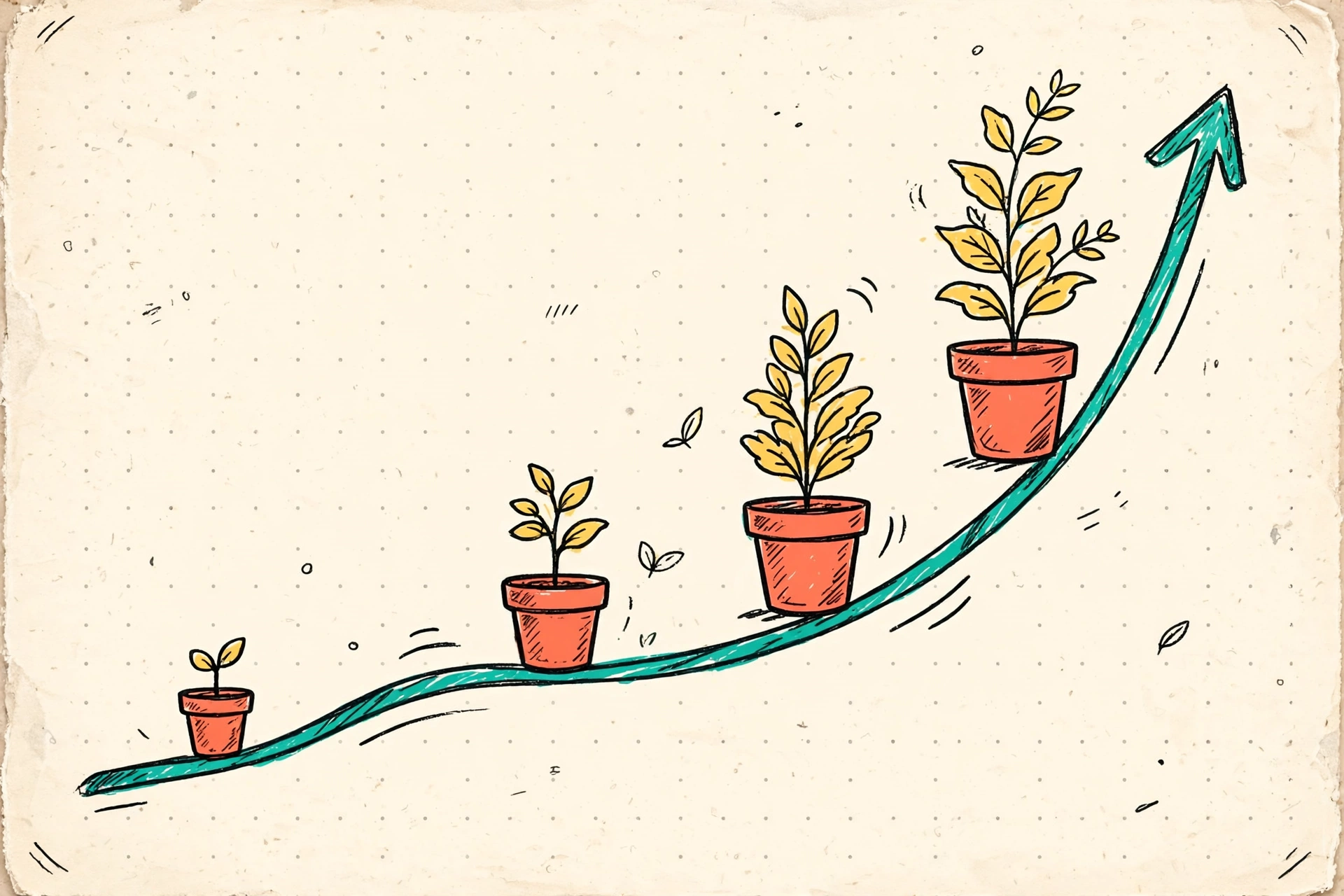
Look at that last line again. You put in $96,000. Compounding contributed the other $429,000. More than four-fifths of the final balance is growth on growth — money your money earned while you were busy living your life.
And notice the shape: the first decade adds about $11,000 in growth; the fourth decade adds over $280,000. Compounding is back-loaded. The early years feel pointless — that’s normal, and it’s exactly why most people quit too soon.
Why Time Beats Timing
Here’s the comparison that ends every “I’m waiting for the right moment to invest” conversation. Two savers each invest $200 a month at 7%:
- Early Emma starts at 25, invests for 10 years, then stops completely. Total contributed: $24,000. At 65, her account holds about $402,000.
- Late Larry waits until 35, then invests $200 a month for 30 straight years. Total contributed: $72,000. At 65, his account holds about $244,000.
Emma contributed one-third as much money and ended up with nearly twice as much — because her money had ten extra years to compound. This is the single most important chart in personal finance: starting early beats contributing more later, almost every time.
The corollary: the “best” time to start was years ago; the second-best time is today. Waiting for a market dip, for the economy to feel safe, for the perfect moment — every year of waiting costs you the most powerful compounding years you’ll ever have, the ones at the end.
Compounding Also Works Against You
Fair warning: the same math that builds wealth destroys it in reverse. Credit card debt at 24% APR compounds against you — your balance grows on its own growth, exactly like the example above but in the wrong direction. A $5,000 balance at 24% with minimum payments can take over a decade to clear and cost thousands in interest. If you want the gory details, read how credit card interest actually works. The lesson: get compounding working for you as early as possible, and stop it from working against you as fast as possible.
How to Actually Put This to Work
Understanding compounding is step one. Capturing it requires exactly two behaviors:
- Invest consistently, automatically. Monthly contributions on autopilot beat occasional lump sums you have to psych yourself up for. Automatic transfers from each paycheck remove willpower from the equation.
- Leave it alone. Compounding needs uninterrupted time. Every withdrawal resets the clock. Market drops are part of the deal — historically, investors who stayed invested through downturns were rewarded; those who sold at the bottom locked in their losses.
Where to put those automatic contributions is the next question. For most beginners, tax-advantaged retirement accounts are the natural home — a workplace 401(k), or an individual account like a Roth IRA, which lets your compounding happen free of annual taxes. The account is just the container; compounding is the engine inside it.
FAQ
Is 7% a realistic return to expect?
Seven percent is a commonly used long-term planning assumption for a diversified portfolio of US stocks, roughly matching historical averages before inflation. But it’s an average over decades, not a yearly promise — individual years range from +30% to -30% and beyond. Use 7% for “what’s possible over 30 years” thinking, never for “what will I have next year” thinking.
Does compound interest apply to savings accounts too?
Yes — savings accounts compound, usually daily or monthly. The math is identical; only the rate is smaller. At a 4% high-yield savings rate, $10,000 becomes about $14,800 in ten years without adding a dime. It’s real compounding, just at a pace suited for money you can’t afford to lose rather than money you’re growing for decades.
What’s the difference between APR and APY?
APR (annual percentage rate) is the simple yearly rate without compounding; APY (annual percentage yield) includes the effect of compounding. A savings account quoting 4.00% APR compounded monthly actually yields about 4.07% APY. When comparing accounts, compare APY to APY — it’s the number that reflects what you actually earn.
Can I still benefit if I’m starting late?
Absolutely — Late Larry still turned $72,000 into $244,000. Starting late just means the math asks more of you: higher monthly contributions, and ideally a longer time horizon (even working a few extra years dramatically helps). The worst response to starting late is not starting at all. Every year you wait, the required monthly amount to reach the same goal goes up.
DotWealthy is for education only, not financial advice. Everyone’s situation is different — consider talking to a qualified financial professional before making big money decisions.