
How to Save for a Down Payment on a House

Saving for a down payment gets a lot easier once you turn it into one clear number. Pick a home price, choose a percentage, add closing costs on top, and keep your emergency cushion out of it. That total is your goal. Everything after that is just a monthly transfer and some patience.
Dot had been saving “for a house someday,” which mostly meant whatever was left at the end of the month. Some months that was $200. Some months it was zero and a vague promise. Wealthy asked one question: “Someday is not a number. What number are we actually aiming at?” That’s where this starts.
How much do you need to save for a down payment?
You need three numbers, not one. Start with a down payment percentage — as low as 3% on many conventional loans and 3.5% on FHA loans, with 20% as the level that skips private mortgage insurance. Then add closing costs of 2% to 5% of the price. Then protect a separate emergency cushion. Add the first two, guard the third, and you have your real target.
Here’s the target, piece by piece:
- Start with a percentage, not a guess. According to the Consumer Financial Protection Bureau (CFPB), most buyers need at least 3% of the home price down, many lenders ask for 5% or more, and FHA loans can go as low as 3.5%. Twenty percent is not a requirement. It’s the line where a conventional loan usually drops private mortgage insurance, or PMI.
- Add closing costs on top. The down payment is not the whole cash bill. The CFPB puts closing costs at typically 2% to 5% of the purchase price, on top of the down payment. Appraisal, title work, lender fees, prepaid taxes and insurance — they all show up at the same closing table.
- Keep your safety cushion out of it. The CFPB suggests holding back an emergency cushion of at least three to six months of expenses, separate from your home money. A house fund that empties every account you own is not a plan. It’s a stressful first month in a new home.
- Run the math on a real price. Percentages feel abstract until you attach them to a house you might actually buy. Pick a price from listings in your area — even a rough one — and do the multiplication. A fuzzy real number beats a precise fantasy.
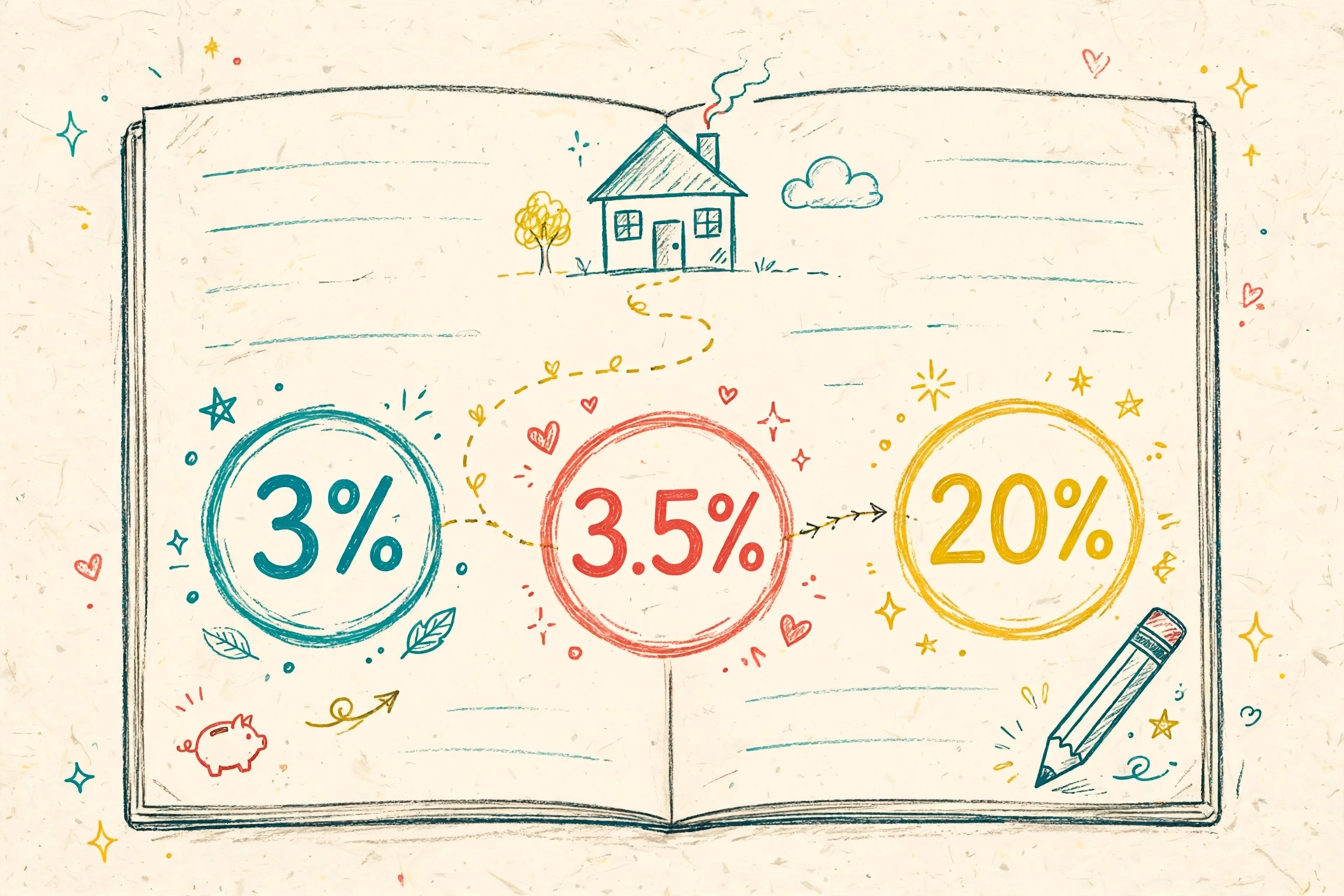
Say the homes you’re looking at run about $350,000. Here’s what each rung looks like in dollars:
| Down payment | On a $350,000 home | What changes |
|---|---|---|
| 3% | $10,500 | Lowest rung on many conventional loans; PMI applies |
| 3.5% | $12,250 | FHA minimum for many borrowers; mortgage insurance applies |
| 10% | $35,000 | Smaller loan, lower monthly payment, PMI still applies |
| 20% | $70,000 | No PMI on a conventional loan |
Now add closing costs at, say, 3% — right inside the CFPB’s 2% to 5% range. That’s another $10,500. So the 10% buyer is not saving $35,000. They’re saving about $45,500, plus whatever cushion they refuse to touch. Dot’s reaction was honest: “So the goal was bigger than I thought — but at least now it’s a goal.” Exactly. A bigger clear number is easier to hit than a smaller fuzzy one.
One more thing about PMI, because it confuses people. PMI protects the lender, not you, if you stop paying. It’s not a scam and it’s not a penalty. It’s the price of borrowing with a smaller down payment, and on a conventional loan it can usually be removed once your balance and home value reach the right point. Whether waiting to dodge it is worth it depends on prices, rent, and your timeline. That’s a math question, not a moral one.
Where should you keep down payment savings?
Keep down payment savings in a separate savings account that you don’t use for everyday spending, apart from your emergency fund. Money you’ll need within a few years has one job: be there. That means boring and safe beats exciting and risky, and a separate account stops the house money from quietly leaking into takeout and plane tickets.
Why separate? Because mixed money gets spent. If your down payment sits in the same account as your grocery money, every balance check lies to you a little. A dedicated account — many people use a high-yield savings account so the balance earns something while it waits — makes progress visible. You open the app, you see the house number, you leave it alone.
And why not invest it for a better return? Time is the problem. Money needed in two or three years can’t ride out a bad stretch in the market, because the market doesn’t check your closing date before it dips. The closer the purchase, the less risk this money can afford. People saving on a much longer timeline sometimes choose differently, and that’s a conversation for a fiduciary adviser who knows your full picture — not a rule anyone can hand you in a blog post.
How long will it take to save a down payment?
Divide your target by a monthly amount you can actually sustain, and you have your timeline. A $40,000 target takes about 80 months at $500 a month before any interest — roughly six years and eight months. Raise the transfer to $750 and it’s about 53 months. The timeline is mostly a dial you turn with the monthly amount, not a mystery.
| Monthly transfer | Time to reach $40,000 (before interest) |
|---|---|
| $300 | About 133 months — just over 11 years |
| $500 | About 80 months — about 6 years, 8 months |
| $750 | About 53 months — about 4 years, 5 months |
| $1,000 | 40 months — about 3 years, 4 months |
Interest on the account shortens those timelines a bit, and raises at work shorten them a lot more. The table isn’t there to depress you. It’s there so you can pick a row on purpose instead of drifting into one by accident.
Run your own down payment timeline
Swap in your own target and monthly amount below and see your date. Try it twice — once with what you save now, once with $50 more — and look at how many months that small bump buys back.
How do you get there faster without doing anything risky?
You get there faster by making the transfer automatic, raising it when your income rises, and sweeping windfalls into the house account before they evaporate. None of that is glamorous. All of it works better than waiting for a month with “extra” money, because that month rarely shows up on its own.
Four habits do most of the work:
- Automate on payday. Set the transfer for the day money lands, not the end of the month. What’s left over is what you live on. That’s the pay-yourself-first idea pointed at a house.
- Bump it with every raise. Got a 3% raise? Send half the increase to the house account before your spending adjusts upward. You won’t miss money you never got used to.
- Sweep the odd money in. Tax refunds, a sold bike, the bonus you forgot was coming. Decide in advance that half of any windfall goes to the house jar. Decide now, while it’s hypothetical and painless.
- Cut one recurring leak. Not ten. One. The subscription stack, the delivery habit, whatever your statement shows three times a month. Redirect that exact amount and name the transfer after what it used to be.
Notice what’s not on that list: picking stocks, timing anything, or putting the house fund somewhere “creative.” Speed comes from the size and steadiness of the transfer. That’s it. Wealthy’s version is shorter: “Boring money, arriving on time, beats exciting money that never arrives.”
Two quick questions before you start
Do I have to save 20% before I can buy a home?
No. The CFPB notes that many loans need as little as 3% down, and FHA loans can go to 3.5%. Twenty percent mainly removes PMI on a conventional loan. Buying sooner with PMI or waiting longer without it is a trade-off to price out with real numbers, not a rule.
Should I empty my emergency fund to reach the goal sooner?
That’s the one move that turns a good plan fragile. The CFPB suggests keeping at least three to six months of expenses as a cushion, separate from your home money. Roofs leak in month one. Keep the cushion, and let the house fund take a little longer.
A down payment stops being a someday wish the moment it becomes arithmetic: a percentage of a real price, closing costs added, cushion protected, one automatic transfer doing the heavy lifting. Pick your rung on the ladder. Set the transfer. Then let the calendar do what willpower alone couldn’t.
For education only, not financial advice. This article explains down payment saving in general terms; loan programs, rates and assistance options vary by lender and location, and a lender or a HUD-certified housing counselor can walk through the specifics for your situation.
This article was created with AI assistance and reviewed by our editorial team before publishing.