
What Is a CD? How Certificates of Deposit Work
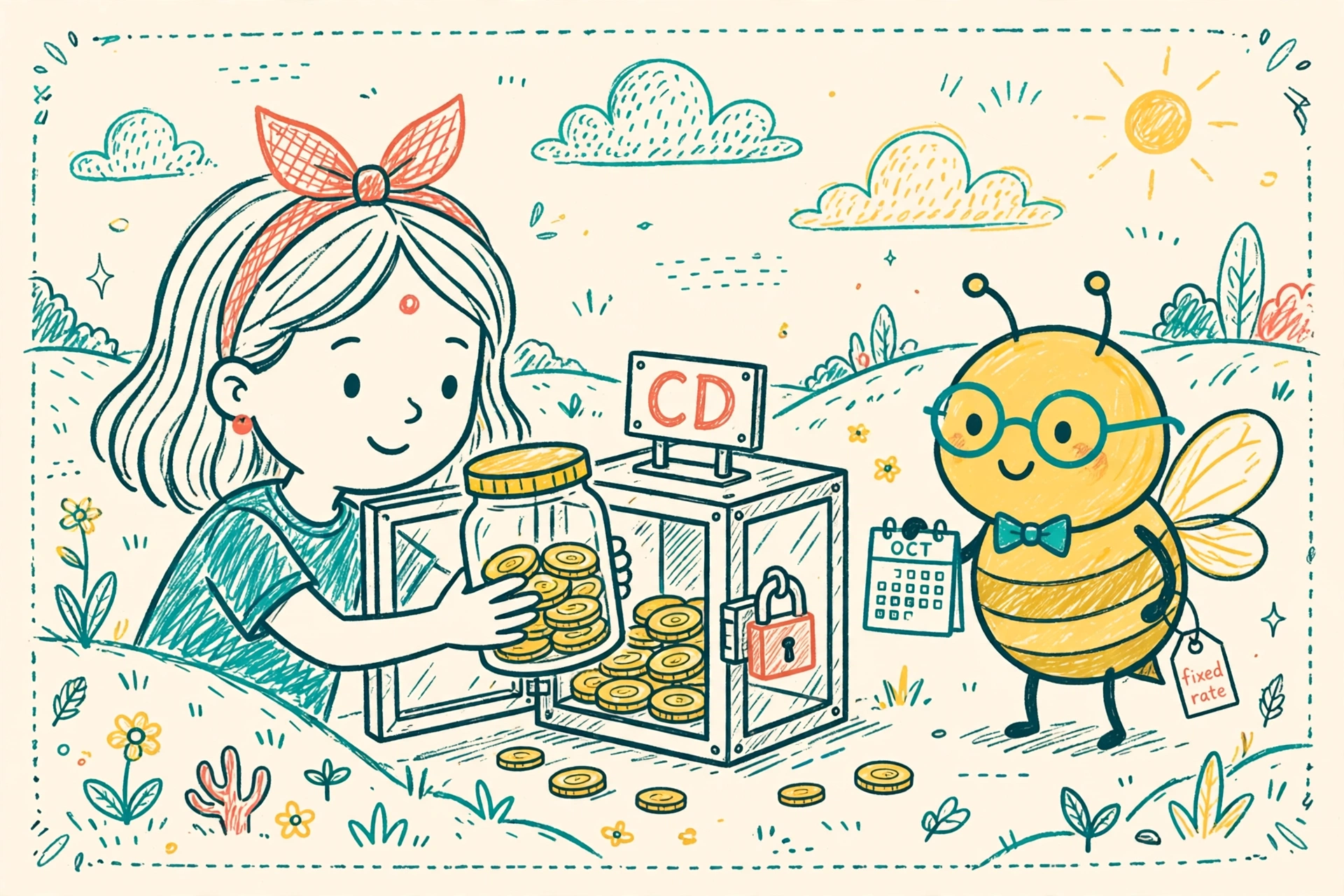
A certificate of deposit, or CD, is a savings account with a trade. You agree to leave your money untouched for a set term, like six months or two years, and the bank pays you a fixed interest rate for the whole term in return.
The trade, in plain English
Dot read a bank offer twice. “Higher rate than my savings account,” she said. “So what’s the catch?”
Wealthy tapped the small print. “Time. You’re selling time.”
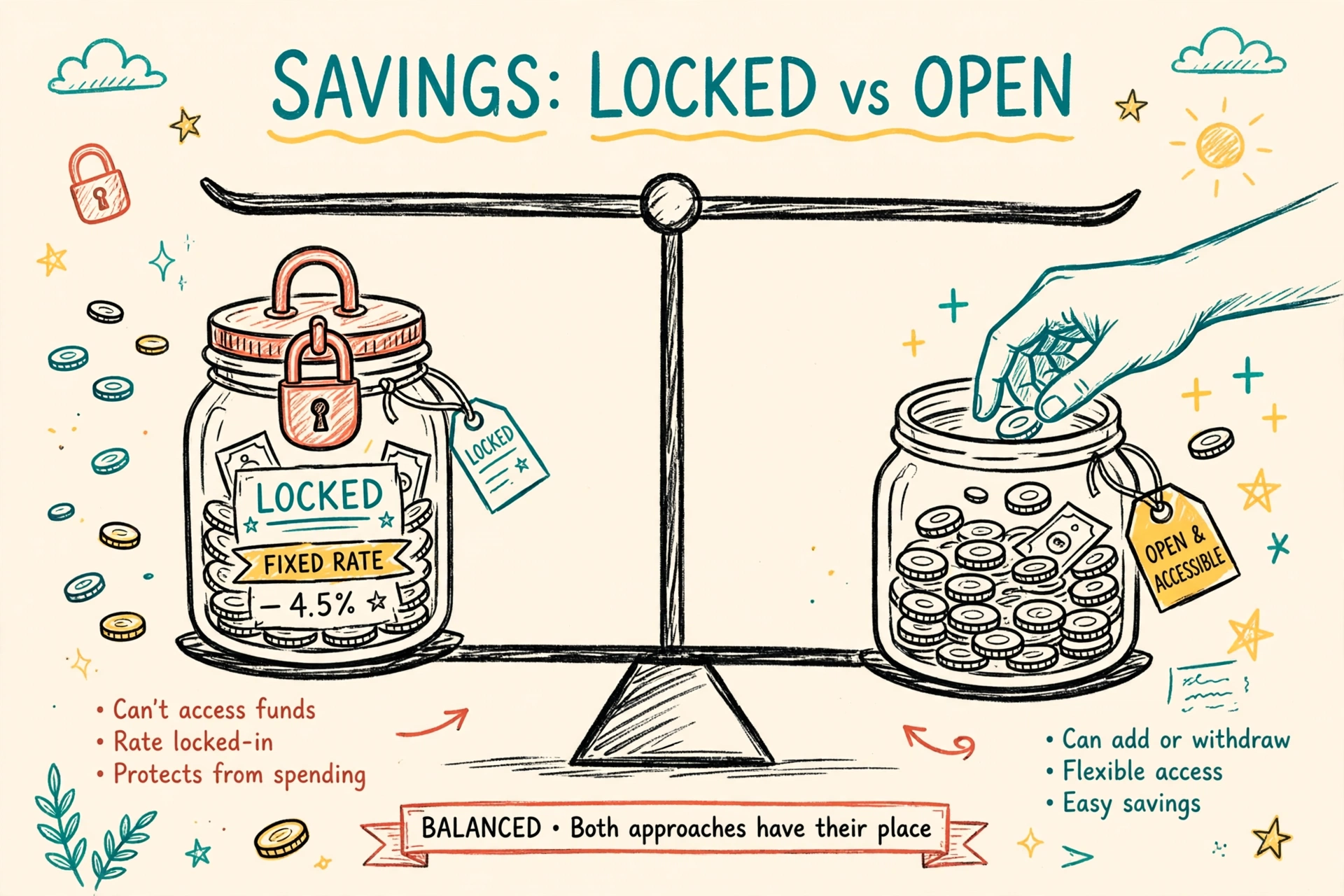
That’s really it. A regular savings account lets you grab your money whenever you want, so the bank can change your rate whenever it wants. A CD flips that deal. You promise not to touch the money until the end date, called the maturity date. The bank promises the rate won’t move, even if rates everywhere else fall next month.
No promise from you, no promise from them. With a promise from both sides, you usually get a better rate. Usually. Not always, and that detail matters later.
How a CD works, step by step
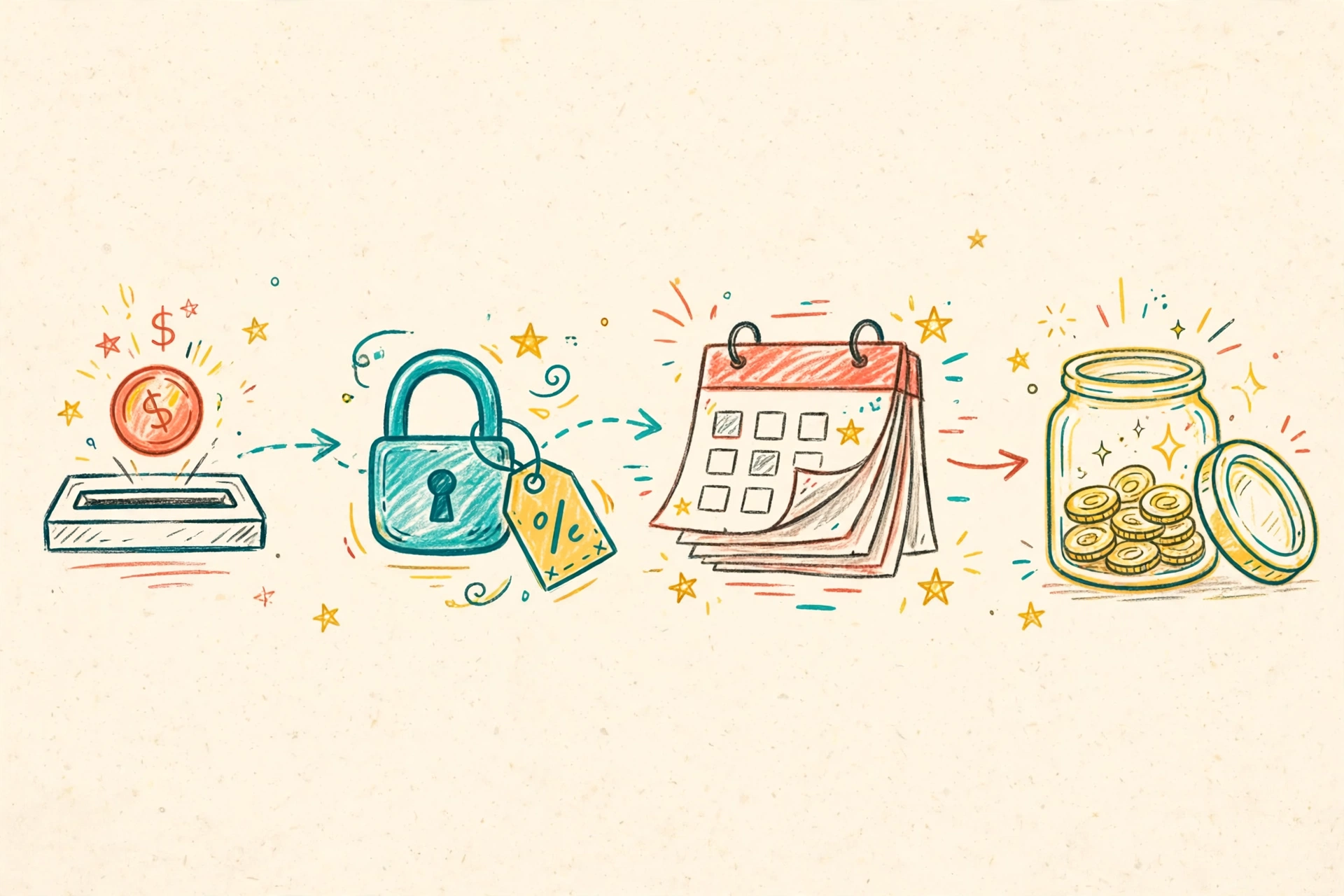
You pick an amount. You pick a term. Then you wait.
Say you put $5,000 into a one-year CD at a fixed rate of 4% a year. That’s a made-up example, not a quote from any bank. If you leave it alone for the full year, the math comes out to about $200 in interest before tax. Simple, boring, predictable. Boring is the point.
Here’s the sequence most people actually go through:
- You open the CD and deposit the money, often with a minimum the bank sets.
- The rate gets locked for that term. It doesn’t drift up or down.
- Interest builds inside the account, usually added monthly or at maturity, depending on the bank’s rules.
- At maturity, you get choices: take the money out, move it, or roll it into a new CD.
That last step sneaks up on folks. Many banks give you a short grace period after maturity, often around a week or so, to decide. Miss that window and some banks renew you automatically into another CD at whatever rate they’re offering then. Set a phone reminder for your maturity date the day you open the account. Future you will be grateful.
What if you need the money early?
Life doesn’t always respect your maturity date. A car dies. A roof leaks.
With most traditional CDs, pulling money out early costs you an early withdrawal penalty. Banks have to spell that penalty out before you open the account, in the deposit disclosures they give you. The penalty is often described as a set number of months of interest, and it can eat into your principal if you bail out very early and haven’t earned much interest yet.
Read that one line before you sign. Not the headline rate. The penalty line.
Some banks sell no-penalty CDs that let you withdraw early without that charge. Sounds perfect, right? The trade-off tends to be a lower rate. You’re buying flexibility back, and flexibility isn’t free.
So ask yourself an honest question before you open one: is this money truly spare until the end date? If the answer is “well, probably,” that’s a no. Keep that cash in a regular savings account where you can reach it.
Is a CD insured?
At an FDIC-insured bank, a CD gets the same deposit insurance as a savings account. According to the FDIC, coverage is up to $250,000 per depositor, per insured bank, for each account ownership category. At a credit union, coverage works in a similar way through the National Credit Union Administration, according to data from the NCUA.
That insurance covers bank failure. It doesn’t protect you from a bad timing choice, and it doesn’t make the interest tax-free. You still owe tax on CD interest in the year it’s earned, even if the money is still sitting in the CD. Your bank sends the tax form, and yes, it counts.
CD vs. high-yield savings: which pot for which money?
People argue about this like there’s one winner. There isn’t. They’re different pots for different jobs.
| Certificate of deposit | High-yield savings account | |
|---|---|---|
| Rate | Fixed for the term | Can change at any time |
| Getting your money | Penalty if you leave early, in most cases | Available when you need it, subject to account rules |
| Best job | Money with a known future date | Emergency fund and flexible savings |
| Adding money | Usually no, after you open it | Yes, deposit whenever you want |
Your emergency fund? That belongs where you can grab it at 2 a.m. Not locked away.
Money for a house deposit you plan to use in 18 months? Or a tax bill you know is coming next spring? Now a CD starts to make sense, because the date is known and the rate is locked while you wait.
The ladder trick people actually use
Dot’s worry was fair. “If I lock it all up for three years and rates rise, I’m stuck.”
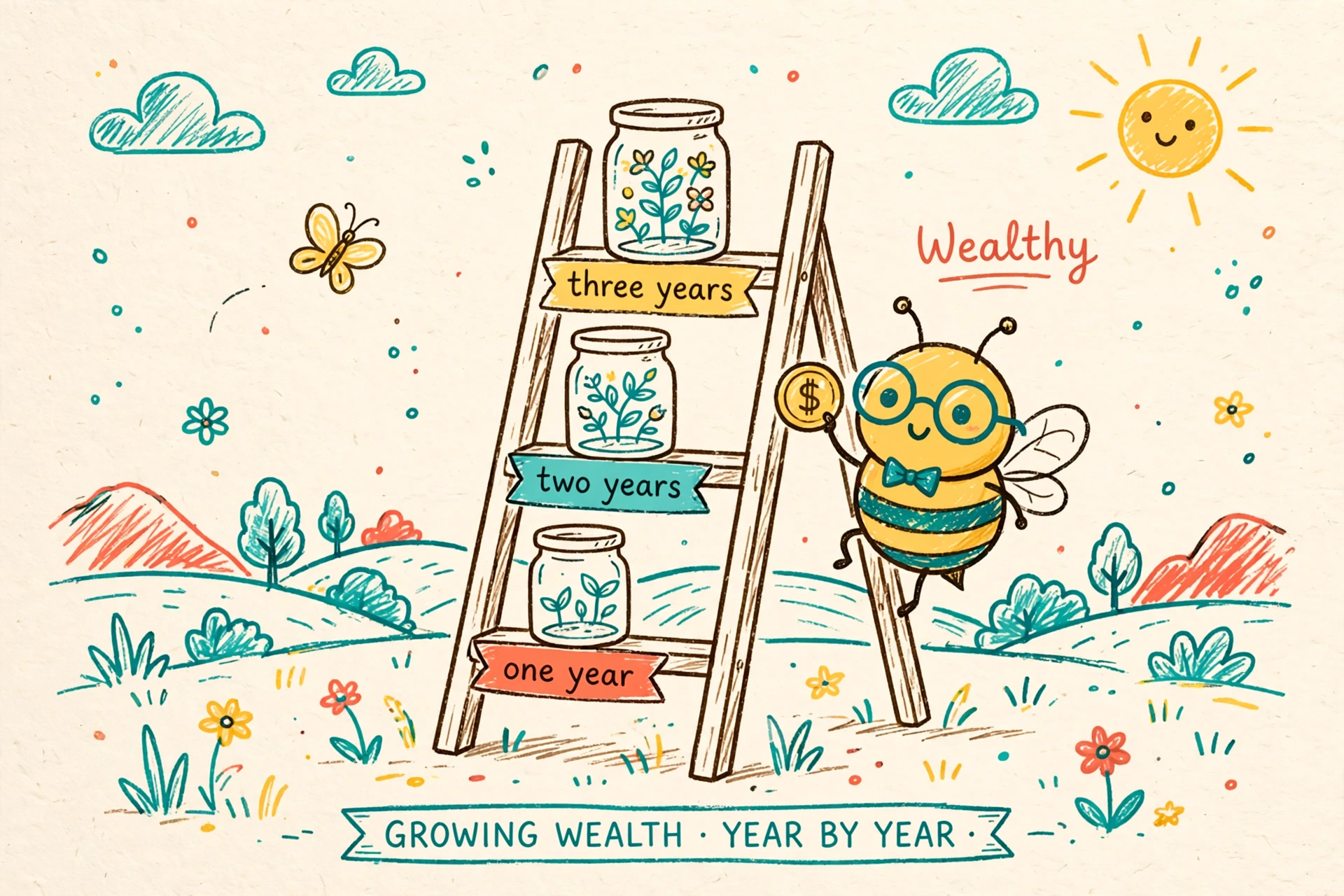
Wealthy’s answer was a ladder.
A CD ladder splits your money across several CDs with different end dates. Picture $6,000 split into three CDs of $2,000 each: one matures in one year, one in two years, one in three years. Every year, one CD frees up. You can spend it, move it, or roll it into a fresh longer CD at the back of the line.
You don’t get the single highest rate on every dollar. You don’t get stuck, either. A ladder is a compromise, and a pretty sensible one if you hate the all-or-nothing feeling of one long term.
Keep it simple at first. Two or three CDs is enough.
Types you’ll see at the bank
Traditional CD. The plain version described above. Fixed rate, fixed term, penalty for leaving early.
No-penalty CD. You can pull your money out early without the usual charge, after any short waiting period the bank sets. Rate is often lower.
Bump-up CD. If the bank raises rates on that CD, you can ask to bump yours up, usually once. The starting rate is often lower, so you’re paying for that option.
Jumbo CD. Built for large deposits, with a high minimum. Bigger doesn’t always mean a better rate, so compare it against the regular CD at the same bank before you assume.
Don’t pick by name. Pick by the penalty rule, the term, and whether the rate beats your current savings account.
Run your own numbers
Thinking about saving toward a dated goal, like a deposit or a planned purchase? Try the free savings goal calculator below to work out what a monthly deposit could add up to over your timeline.
When a CD fits, and when it doesn’t
A CD can fit when you’ve got a lump sum, a clear future date, and no need to add to it along the way. School tuition due next fall. A wedding fund with a date on a calendar. Money you’d otherwise leave sitting in checking, slowly leaking out on takeout.
It’s a poor fit in a few common spots. Your only emergency savings. Money you’ll need to add to every payday. Cash you might need for a job change or a move. And it’s a poor fit if you haven’t checked the rate at all — some CDs pay barely more than a savings account, and locking your money up for a tiny extra sliver isn’t much of a deal.
One more check. If you’re carrying expensive credit card debt, paying that down will almost always help you more than a CD will earn you. Don’t lock money away at a modest rate while a much higher rate is quietly charging you on the other side of the ledger.
How to open one without the usual mistakes
- Compare the CD rate with the rate on a high-yield savings account at the same bank. If there’s barely a gap, flexibility may be worth more.
- Read the early withdrawal penalty in writing. Say it back to yourself out loud: how many months of interest, and can it touch my original deposit?
- Match the term to a real date. Don’t pick three years because the rate looks nicer if the bill is due in one.
- Write down the maturity date and the grace period in your calendar, with a reminder a few days before.
- At maturity, decide on purpose. Don’t let an automatic renewal pick your next term for you.
That’s the whole skill. Not picking the perfect bank. Just matching the term to your life and reading two lines of small print.
Questions people ask about CDs
Do you pay tax on a CD if you don’t withdraw the money?
Yes, in most cases. Interest is generally taxed in the year it’s earned, even if it stays in the CD until maturity. Your bank reports it on a tax form. A tax professional can help if your situation is more complicated than a single CD.
Can you lose money in a CD?
Your deposit is insured up to the limits described above if the bank is FDIC-insured. You can still lose out in other ways: an early withdrawal penalty can cut into your deposit if you leave very early, and a fixed rate can fall behind inflation while your money is locked in.
Can you add money to a CD after opening it?
Usually no. Most traditional CDs take one deposit at the start. If you want to keep adding money each month, a savings account you top up regularly, then move into a CD later, is often the cleaner route.
What happens when a CD matures?
You get a grace period to withdraw, move, or renew the money. If you do nothing, many banks renew it automatically into a new CD at the rate they offer at that time. Check your bank’s rule when you open the account, not after.
For education only, not financial advice.
This article was created with AI assistance and reviewed by our editorial team before publishing.